




Wilmar’s crushing margins defy global oilseed slump as profit rises to US$1.28B

Key takeaways
- Wilmar’s core net profit rose 10% to US$1.28 billion for FY2025, with Feed & Industrial Products pre-tax profit surging 62% in H2 on stronger crushing margins.
- Palm oil production declined 2% for the full year on unfavorable Indonesian weather, while the company deepened its India presence through AWL consolidation.
- CEO Kuok Khoon Hong flags geopolitical tensions and trade tariffs as defining headwinds, with 2026 expected to remain challenging.
Wilmar International, Asia’s largest agribusiness group, has posted a 10% rise in core net profit to US$1.28 billion for FY2025, driven by a sharp improvement in oilseed crushing margins that propelled its Feed & Industrial Products segment to a 62% profit jump in the second half. Full-year revenue climbed 4.5% to US$70.4 billion.
The results come against a backdrop of escalating trade tariffs, geopolitical disruption across key commodity corridors, and shifting regulatory landscapes — conditions that chairman and CEO Kuok Khoon Hong describes as making 2025 “a challenging year for the group.” Palm oil production dipped during the year, though the group’s integrated model helped absorb margin pressure across its consumer-facing businesses.

The Feed & Industrial Products segment — spanning tropical oils, oilseeds and grains, and sugar — was the standout performer. Pre-tax profit surged 62% to US$479.4 million in the second half, driven by higher crushing margins and improved contributions from sugar merchandising. For the full year, segment profit edged up 4% to US$861 million.
Overall segment sales volume dipped 1% to 68 million metric tons for the year, and sugar sales volume fell in H2. Tropical oil margins were compressed during the period — meaning the crushing operations carried the segment’s profitability largely on their own.
The performance stands in contrast to the margin environment facing oilseed processors elsewhere. ADM’s crushing profit collapsed 81% in FY2025 on the back of US biofuel policy uncertainty, with increased industry capacity and weaker vegetable oil demand compounding the pressure.
Food products: Volumes up, margins squeezed
On the consumer-facing side, Wilmar’s Food Products segment — covering edible oils, flour, rice, and sugar branded for end markets — saw volumes grow 5% for the full year to 34.7 million MT. But pre-tax profit declined 10% to US$449.7 million.
The flour and rice businesses both improved, though weaker results from sugar offset those gains. The H2 comparison is also skewed by a one-off pre-tax gain recognized in the second half of 2024 from a share swap exercise involving the group’s China associates and joint venture, Luhua. Excluding that gain, Wilmar says H2 profitability was broadly comparable year-on-year.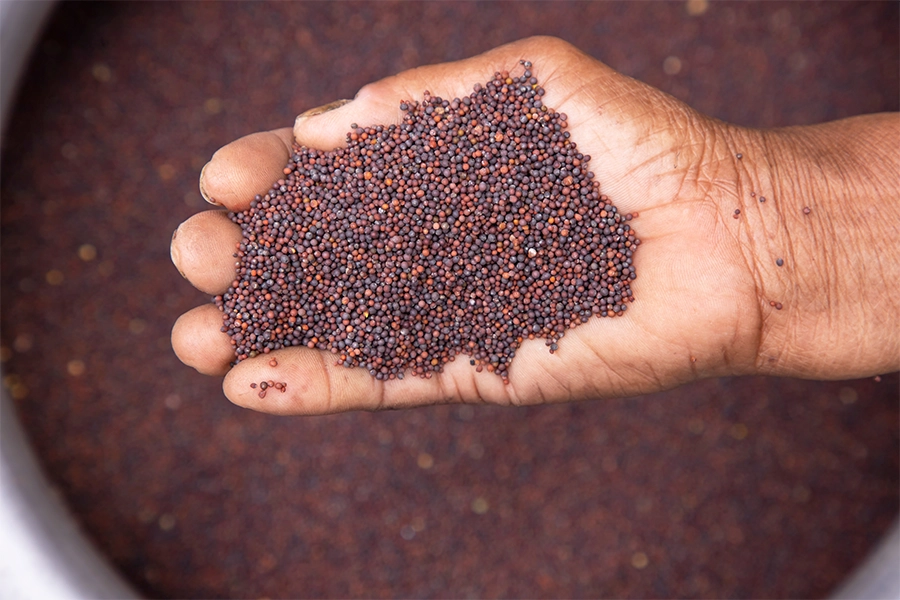 Wilmar’s FY2025 core net profit rose 10%, as strong crushing margins boosted H2 performance despite weaker palm output and geopolitical trade pressures.
India bet deepens through AWL
Wilmar recorded a US$1.14 billion gain on remeasurement arising from changes in its interest in AWL Agri Business, its Indian associate. While classified as a non-core item, the move deepens Wilmar’s presence in India’s food processing and distribution infrastructure — a market where edible oils consumption continues to grow. The US Foreign Agricultural Service projects India will import 8.7 million MT of vegetable oils in the 2025-26 marketing year, up 11.5% from the prior year.
AWL’s results began consolidating in Q4 2025, contributing to Food Products volume growth. Wilmar’s integrated model — from raw material sourcing through to branded consumer products — is designed to capture value at multiple points along that chain.
Palm output falls as supply pressures build
The Plantation & Sugar Milling segment posted a 32% rise in full-year pre-tax profit to US$356.5 million, supported by stronger palm oil prices and higher sugar sales volumes during the first half. But during the second half, segment profit fell 28% as palm prices weakened and fresh fruit bunch (FFB) production dropped 8% to roughly 2 million MT on adverse weather conditions in Indonesia. Full-year FFB output declined 2% to 4.04 million MT.
The supply picture for palm oil heading into 2026 is mixed. Indonesia’s planned B50 biodiesel mandate could tighten exportable supply significantly, while EU sanctions on Russian fertilizers threaten to drive up potash costs for Indonesian growers — adding structural cost pressure on top of weather-related yield volatility.
Trade headwinds
Kuok points to geopolitical tensions, trade tariffs, and evolving regulatory landscapes as requiring the group to “adapt our supply chain and business model.” He adds: “Leveraging on our global manufacturing and distribution network, and further supported by a dedicated and resilient workforce, we managed to overcome these challenges and reported a reasonable set of results for FY2025.”
The cautious tone mirrors that of other major Asian agribusiness groups. Olam Food Ingredients posted essentially flat EBIT for FY2025, with CEO A. Shekhar citing “one of the most volatile commodity markets and uncertain trade environments in recent memory.” Kuok expects operating conditions to “continue to remain challenging” in 2026, with results forecast to be “satisfactory” barring unforeseen circumstances.
Net debt rose US$1.32 billion to US$19.96 billion — largely due to the AWL consolidation — though net gearing improved to 0.91x. Capital expenditure was scaled back 31% to US$1.08 billion, with Wilmar noting that most of the expansion of its core businesses has now been completed. The total dividend for FY2025 is S$0.14 (US$0.10) per share, down from S$0.16 (US$0.12) the prior year, a reduction the group links to one-off non-core cash adjustments.