


ofi reports flat earnings as commodity volatility reshapes Olam Group’s breakup year

Key takeaways
- ofi’s operating profit held steady at S$1.1 billion (US$815 million) despite wild swings in cocoa and coffee prices, though earnings didn’t grow.
- Revenue jumped 30.6% to S$28.5 billion (US$21.1 billion), largely because higher raw material costs were passed on to customers — not because of increased sales volumes.
- Parent company Olam Group is still completing its breakup, with the US$4 billion sale of its farming and trading arm to Saudi Arabia’s SALIC awaiting final approval.
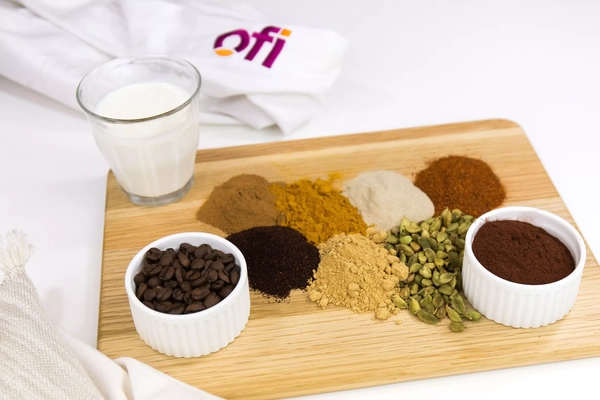
Olam Food Ingredients (ofi) posted essentially flat full-year operating profit of 1.1 billion Singapore dollars (US$815 million) for 2025, as the cocoa, coffee, dairy, nuts, and spices business absorbed what CEO A. Shekhar calls “one of the most volatile commodity markets and uncertain trade environments in recent memory.”
Revenue surged 30.6% to S$28.5 billion (US$21.1 billion), driven almost entirely by pass-through pricing of elevated cocoa and coffee costs rather than volume growth. The results come as parent Olam Group nears the end of a prolonged corporate breakup, with its US$4 billion sale of Olam Agri to Saudi Arabia’s SALIC still awaiting final regulatory clearance.

Resilience amid commodity price swings
ofi’s full-year EBIT declined 0.1% year-on-year, with second-half earnings slipping 10.3% to S$533.7 million (US$395 million). Shekhar says: “Despite significant swings in commodity markets, our teams around the world stayed focused on serving customers, supporting farmers and suppliers, and executing on long-term strategy.”
The company’s 30.6% top-line growth reflects the pass-through of record cocoa and coffee input costs to customers, not underlying demand expansion. Cocoa futures peaked above US$12,000 per ton in late 2024 before collapsing through 2025, while arabica coffee hit historic highs in February 2025.
European cocoa processing volumes fell approximately 3% in late 2025 — the largest decline in 11 years — as manufacturers reformulated products and reduced cocoa content to manage costs.
Cocoa normalization, coffee uncertainty
Group CFO N. Muthukumar says cocoa price normalization drove a substantial improvement in the company’s cash position. “The prices of cocoa have started to normalize, which led to the decrease in working capital, enabling the Group to strengthen its overall cash flow position in 2025,” he says. Free cash flow to equity swung from negative S$5.9 billion (US$4.4 billion) in 2024 to positive S$359.6 million (US$266 million), while net gearing improved from 2.79x to 2.69x.
.webp) ofi posted flat EBIT of S$1.1 billion (US$815 million) despite a 30.6% revenue surge driven by elevated cocoa and coffee input costs.The timing is significant. Cocoa has since fallen below US$4,000 per ton for the first time since October 2023 — roughly 70% below its peak. Commodity research firm StoneX projects global surpluses of 287,000 tons for 2025/26 and 267,000 tons for 2026/27, driven by improved West African harvests and demand destruction. However, Rabobank commodity analyst Oran van Dort has cautioned that systemic supply-side issues in Côte d’Ivoire and Ghana will persist, and prices are unlikely to return to historical levels within the next two years.
ofi posted flat EBIT of S$1.1 billion (US$815 million) despite a 30.6% revenue surge driven by elevated cocoa and coffee input costs.The timing is significant. Cocoa has since fallen below US$4,000 per ton for the first time since October 2023 — roughly 70% below its peak. Commodity research firm StoneX projects global surpluses of 287,000 tons for 2025/26 and 267,000 tons for 2026/27, driven by improved West African harvests and demand destruction. However, Rabobank commodity analyst Oran van Dort has cautioned that systemic supply-side issues in Côte d’Ivoire and Ghana will persist, and prices are unlikely to return to historical levels within the next two years.
Coffee remains a different story. Arabica prices, while moderating, are still high by historical standards, and Brazil’s combined arabica and robusta harvest is forecast to decline 2 million bags in the current season due to drought-affected flowering. ofi’s outlook statement acknowledges the divergence, noting the company “is beginning to see normalization in market conditions for some of its key input raw materials like cocoa and coffee.”
Competitive and consumer context
The results land amid shifting dynamics across ofi’s core categories. Barry Callebaut’s Q1 fiscal 2025/26 results showed group volumes down 9.9% year-on-year, with chocolate volumes declining 6.8% even as cocoa prices eased. Innova Market Insights data cited in that report suggests US consumers are not intentionally reducing chocolate consumption — the decline appears price-driven, with potential for recovery as costs stabilize.
That consumer resilience aligns with Innova’s 2026 trend forecasts, which identify “Layers of Delight” — multi-sensory indulgence — and sustainability-backed sourcing as key purchasing drivers. ofi’s Cocoa Compass traceability program won the Sustainability Innovation Award at Fi Europe 2025 in Paris, France, and its agroforestry partnership with Nestlé — billed as the largest ever in cocoa — positions the company for the EU Deforestation Regulation compliance deadline of December 30, 2026.
The bigger picture
At the group level, Olam reported PATMI up 414% to S$444.1 million (US$329 million), though this largely reflects a low 2024 base depressed by exceptional items. Operational PATMI, excluding one-offs, rose 136.2% to S$510.9 million (US$378 million).
The Board has opted not to recommend a final dividend, saying it is “prudent to conserve cash at this time to ensure operational resilience,” while the SALIC transaction and broader reorganization are completed.
ofi’s medium-term guidance targets high single-digit adjusted EBIT growth — a commitment that has held as an aspiration through multiple cycles of volatility but is yet to be tested in a normalizing market. With cocoa and coffee prices now retreating and trade policy uncertainty mounting, the coming year will reveal whether ofi can convert its resilient performance into earnings growth.