


Landmark EU case could force timeline for phasing out cage farming

Key takeaways
- The Court of Justice of the EU heard the first case of its kind, pressing the commission to commit to a legislative timeline on caged farming.
- A public consultation on EU animal welfare laws drew over 190,000 responses, with near-unanimous support for phasing out cages across all farmed species.
- Ahold Delhaize has published a new cage-free commitment for its US supply chain after missing deadlines in 2016 and 2019.
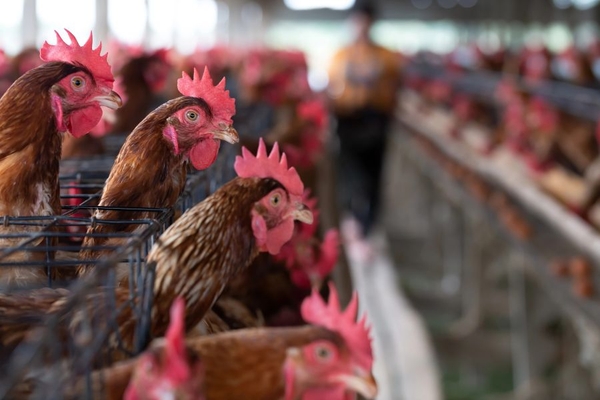
Five judges at the Court of Justice of the EU (CJEU) pressed the European Commission’s representatives last week on why they could not commit to a legislative timeline for banning caged animal farming, as separately published consultation results confirmed near-unanimous public support for phasing out cages. Meanwhile, major Dutch-Belgian grocery retailer Ahold Delhaize published a new cage-free commitment days earlier, years after missing its own cage-free pledges.
The case was brought before the CJEU on March 5 by the End the Cage Age Citizens’ Committee, led by Compassion in World Farming (CIWF), alongside Eurogroup for Animals, Animal Equality, and animal protection organization LAV. It marks the first time a court has been asked to hold the commission accountable under the European Citizens’ Initiative (ECI) regulation.

In 2021, following the End the Cage Age ECI, backed by more than 1.4 million signatures and 170 civil society organizations, the commission pledged to propose legislation banning caged farming by 2023. Leading EU NGOs filed the case in June 2024 after the commission missed that deadline without explanation.
The court is being asked to rule on whether the commission’s 2021 commitment to legislate constituted a binding obligation under the ECI regulation, and whether its failure to act was unlawful. A ruling in the applicants’ favor could compel the commission to publish a concrete legislative timeline — and would set a precedent for the enforceability of all future ECIs.
Professor Alberto Alemanno of HEC Paris and founder of non-profit The Good Lobby, says: “This is a landmark moment — the first time a court has been asked to hold the commission accountable for breaking a promise made to citizens under the ECI. The answer will tell us whether participatory democracy in the EU is real, or merely decorative.”
Public and industry support
The hearing followed the commission’s publication on February 27 of its public consultation results on modernizing EU animal welfare legislation, which drew more than 190,000 responses between September and December 2025.
Results show 99% of respondents — including 54% of businesses — consider phasing out cages for laying hens important or very important, with near-identical figures recorded for pigs, calves, rabbits, and ducks. Some 89% said current EU legislation does not allow animals to express their natural behaviors, and 88–92% said EU welfare requirements should apply equally to imported products. EU democracy faces a key test as the court of justice weighs whether the commission must honor its pledge to legislate a ban on cage farming.
The results follow a December 2025 push by more than 30 European food companies — including Lidl, Sodexo, and Ferrero — urging the commission to legislate before the consultation closed.
Vinciane Patelou, head of CIWF’s EU office, tells Food Ingredients First the results leave no room for ambiguity. “Hundreds of thousands of people took the time to respond to this consultation, and their message couldn’t be clearer — 99% support phasing out cages and 89% say current laws aren’t good enough. This only strengthens our commitment to hold the commission accountable for its broken promises.”
She adds that the coalition made “a clear and compelling case” at the hearing, and that the ruling “is not only crucial for animal welfare and the 300 million animals still suffering in cages — it’s also vital for democracy, as it’s the first of its kind to hold the commission to account for its failure to act on an ECI that it has committed to deliver.” Animal welfare groups had been ramping up pressure on EU policymakers since at least February 2025, ahead of the expected 2026 policy review.
Retailer action on cage farming
On March 3, Ahold Delhaize — the Dutch-Belgian conglomerate behind Albert Heijn, Stop & Shop, Giant, Food Lion, and Hannaford in the US — published a near-term timeline to eliminate battery cages from its American supply chain, after missing cage-free pledges made in both 2016 and 2019.
The announcement follows a sustained pressure campaign by the International Council for Animal Welfare (ICAW) involving nearly a dozen undercover supply chain investigations, hundreds of protests across the US and Europe, and tens of thousands of digital actions. The commitment will affect an estimated 7 million hens annually. Ahold Delhaize was approached for comment.
The transition is commercially achievable. Sweden’s egg sector reached full cage-free status in June 2025, with industry cooperation enabling competitive pricing despite higher production costs — a template that advocates argue is replicable across larger markets. The picture elsewhere has been patchier: UK retailers including Asda, Lidl, and Morrisons faced scrutiny in July 2025 over missed cage-free targets, underlining that voluntary commitments without regulatory backing remain vulnerable to delay.
ICAW is now calling on Walmart, Kroger, and Albertsons — all of which have their own stalled cage-free commitments — to follow Ahold’s lead, suggesting the retail pressure dynamic is far from resolved on the other side of the Atlantic.
Reineke Hameleers, CEO of Eurogroup for Animals, says the Luxembourg hearing represents a pivotal moment beyond animal welfare alone. “If citizens place their trust in shaping EU policies that directly affect their lives, the European Commission must be held accountable for delivering on its commitments. It is high time that the promise to end cages in farming systems is finally honoured.”
The commission has indicated it intends to bring forward revised animal welfare legislation by the end of 2026. Hundreds of millions of animals remain confined in cages on EU farms every year while that process continues.