




Saltwell expands Chile operations to scale low-sodium salt production

Key takeaways
- Saltwell Group launches a facility in Chile to scale its 35% reduced sodium salt solution amid rising regulatory pressure.
- The company’s natural 1:1 salt replacement supports compliance with global health targets, without compromising taste or functionality.
- Unlike potassium blends, Saltwell maintains flavor, clean label status, and processing performance across snacks, bakery, and processed foods.
 Opening of Saltwell’s new Chile facility (Image credit: Victor Bravo-Saltwell).
F&B companies are facing mounting pressure to cut sodium levels in their products, particularly in snacks, where a drop-off in taste due to salt reduction can decrease consumer acceptance. Sweden-based Saltwell Group has unveiled a new production facility in Santiago, Chile, to tackle these challenges through its one-to-one replacement for standard salt, branded “Saltwell.”
The ingredient is said to contain up to 35% less sodium for use in snacks, processed meats, ready meals, sauces, cheeses, and baked foods.
The new site will help the company increase production of a low-sodium salt at a time when front-of-pack labeling schemes help consumers to compare the nutritional value of products at a glance — an issue CEO Anders Hansson says “manufacturers cannot ignore.”

The site will enhance production of the salt replacer and support manufacturers in meeting public health recommendations and requirements to lower sodium in diets “without sacrificing flavor,” he tells Food Ingredients First.
“Saltwell also addresses the greater scrutiny of ingredient lists by consumers. It is the only solution that delivers sodium reduction while maintaining ‘salt’ on the ingredient panel and clean label compliance at the same time.”
“Switching out standard salt for Saltwell means it’s possible for manufacturers to gain a first-mover advantage, reducing the competitive risk of delays in reformulation processes, and offering opportunities to create a premium positioning in retail environments,” Hansson emphasizes.
How Saltwell’s low-sodium salt is made
Saltwell Group is a division of Salinity, one of the world’s oldest salt companies. It obtains its salt replacement ingredient through solar evaporation and modern sea salt production processes, using hypersaline water resources from the Atacama salt flats — the biggest salt deposit in Chile with a surface area of 750,000 acres.
 Anders Hansson: Saltwell reduces sodium while keeping “salt” on the ingredient label and meeting clean label demands (Image credit: Josef Hübsch).“These waters contain a unique balance of sodium and potassium salts and trace minerals, which, when dried in the sun, combine to become a natural mineral in a single crystal structure with 35% less sodium than standard salt,” Hansson explains.
“Since its mineral balance is created by nature rather than mechanical blending, Saltwell provides a clean, rounded, consistent salty flavor profile comparable to standard salt, with similar functional properties.”
Sodium reduction becomes industry priority
Hansson describes sodium reduction as a “defining priority” for food manufacturers as reduced salt foods turn into a mainstream consumer demand. Nearly 25% of consumers globally view low salt claims as crucial to making indulgent foods “feel healthier,” finds an Innova Market Insights survey.
“Global, regional, and national health organizations, including the WHO and the US FDA, have called on food manufacturers to help consumers lower their sodium intake by as much as 30%. This reflects scientific consensus linking excessive consumption to cardiovascular health risks,” Hansson says.
WHO data shows that in 2023, the average global sodium intake was more than double what the organization recommends (2,000 mg per day), while only 5% of WHO member states had comprehensive sodium reduction policies.
Overcoming sodium reduction challenges
The challenge for food manufacturers is to reduce sodium without negatively impacting taste or the functions salt performs.
“Most sodium‑reduction strategies rely on mechanically blending sodium chloride with potassium chloride. For R&D teams, this means rewriting recipes and recalibrating processes, adding not just production costs but risks, too,” says Hansson.
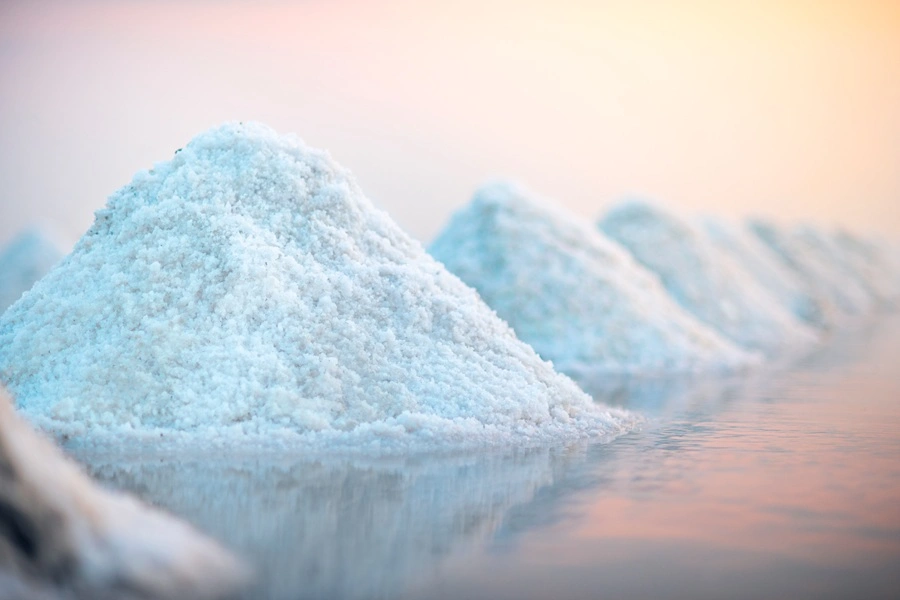 Saltwell’s salt from Chile’s Atacama flats delivers 35% less sodium through a natural solar evaporation process (Image credit: Theeraphong).“While these blends can meet sodium targets on paper, they often yield off-flavors, bitterness, or metallic notes. Mechanically blended mineral salts can also present challenges in production processes due to grain segregation or inconsistent behavior.”
Saltwell maintains conventional salt processing performance and helps manufacturers use it as a like-for-like replacement with “minimal process adjustment” and no significant negative impact observed in tested food systems. “In many cases, eating quality has been shown in tests to be improved,” he adds.
Low-sodium salt across food applications
Saltwell Group’s “healthier and clean label” salt replacer offers similar sensorial properties and functionality in a wide range of tested food applications.
For snacks, Saltwell is available in a unique “Microfine” grade, which Hansson describes as the “only natural single‑grain, 50‑mesh salt available globally,” offering up to 40% sodium reduction in these products.
In bakery formulations — where salt is critical for flavor delivery and functionality — replacing standard salt one-for-one with Saltwell is said to maintain full salt functionality. This includes yeast control, dough handling, and flavor balance, “while enabling a significant reduction in sodium content,” supporting sensory performance and nutritional reformulation.
Meanwhile, processed meats require salt for flavor as well as shelf life extension. “Saltwell makes it straightforward to reduce sodium with comparable performance across all parameters,” says Hansson.
“In all applications, Saltwell preserves the flavor upon which long‑term loyalty is built. It proves that public health goals and consumer pleasure can genuinely coexist — and that healthier food no longer requires a sensory sacrifice.”