


ISM 2026 live: Cocoa volatility reshapes chocolate innovation as alternatives go global


Key takeaways
- Planet A Foods debuts soy-based ChoViva at ISM 2026, expanding its cocoa-free chocolate alternative to Asian markets through regional supply chains.
- Cocoa-free alternatives shift from crisis response to permanent portfolio strategy.
- Manufacturers segment portfolios between premium cocoa for high-indulgence occasions and alternatives for everyday formats.

ISM & ProSweets 2026 is underway in Cologne, Germany, amid one of the most turbulent periods the cocoa market has seen in decades. The world’s largest confectionery trade fair — featuring 1,656 exhibitors from 71 countries and an expected 37,500 trade visitors — arrives 12 months after cocoa prices hit record highs. Prices have since crashed more than 50%, but the industry is still accelerating investment in cocoa-free solutions and reformulation strategies for long-term resilience.
On the show floor, Food Ingredients First speaks with key suppliers, including Cargill and Planet A Foods, a commercial partner of Barry Calleubaut, to understand what’s driving innovation in chocolate and cocoa alternatives, how manufacturers are responding to ongoing volatility, and what trends are shaping the confectionery landscape.
Among the fair’s 680 chocolate exhibitors, cocoa alternatives are featured prominently. A new “ISM Functional Sweets” area in Hall 10.1 highlights products combining indulgence with added benefits, while the 2025 edition’s ISM Consumer Award notably went to Treets Crunchy Corn Vegan with ChoViva — a sunflower seed-based chocolate alternative developed by Planet A Foods.
The paradox of falling prices
The disconnect between price relief and continued reformulation reveals how deeply last year’s volatility reshaped industry thinking. Cocoa futures traded around US$6,000–US$6,300 per metric ton in December 2025, down from a peak of US$12,931 — yet major brands including Nestlé and Pladis dropped “chocolate” labeling from UK products after reformulated recipes fell below legal cocoa content minimums.
Barry Callebaut’s Q1 fiscal 2025/26 results, released last month, underscore the lingering effects. Group volumes fell 9.9%, with Global Chocolate down 6.8% despite cocoa bean prices averaging 16% lower year-on-year. Consumer demand remains soft as the industry navigates what the company calls “post-crisis behavioral changes.”
The Swiss chocolate giant is responding with around 600 R&D projects in cacao coatings and the international rollout of ChoViva through its partnership with Planet A Foods. As we reported in December, the company is also reportedly exploring separating its cocoa division from chocolate manufacturing — a potential structural break that would reshape how the sector manages supply chain risk.Cargill’s CBE (Cocoa Butter Equivalent) alternative chocolate products on display at ISM & ProSweets 2026.
From curiosity to industrial scale
For Planet A Foods, ISM & ProSweets 2026 marks a turning point. The Munich-based company exhibited at ISM for the first time in 2024, when cocoa-free chocolate was still a novel innovation area. This year, it returns with 125 products containing ChoViva available in 10 countries and a global commercial partnership with Barry Callebaut.
“When we first exhibited at ISM in 2024, cocoa-free chocolate was a brand-new innovation that many viewed as a curiosity. Now, in 2026, we are here for the third time with a clear focus: globalization and scaling,” Dr. Sara Marquart, co-founder of Planet A Foods, tells Food Ingredients First at the company’s booth.
The technology has matured rapidly. ChoViva uses fermented and roasted sunflower seeds to replicate the flavor complexity of traditional chocolate, and Marquart says it can now be produced locally anywhere in the world. At ISM, the company is debuting soy-based ChoViva specifically developed for the Asian market — demonstrating adaptability to regional supply chains.
Dr. Maximilian Marquart, also co-founder of Planet A Foods, positions the product as both a cost and sustainability solution.
“From a sustainability and resilience perspective, our short supply chains — using European sunflower seeds — save approximately 80% of CO2 emissions and secure our partners’ supply chains for the future,” he says. “Economically, sunflower seeds are a cost-effective solution; because they are completely decoupled from the volatile cocoa market, we can offer long-term price stability that traditional chocolate cannot match.”
According to Innova Market Insights, patent activity in cocoa-free chocolate is growing, with Voyage Foods, WNWN Food Labs, Nukoko, and Planet A Foods among start-ups holding intellectual property in the space. The category is moving from niche experimentation to formal IP protection.
Portfolio segmentation takes hold
Anne Mertens-Hoyng, bakery category senior director at Cargill, says manufacturers are now actively mapping where traditional chocolate, cocoa-optimized solutions, and alternatives make sense across different products, markets, and price points.
“Cocoa price volatility has fundamentally changed how manufacturers approach reformulation. What was once a tactical exercise is now a strategic one,” Mertens-Hoyng tells Food Ingredients First. “When prices reached record highs, it reinforced the reality that relying on a single, climate-exposed raw material carries significant risk.”
The result is increasing portfolio segmentation. Premium products tend to protect traditional chocolate cues, while high-volume and value tiers are more open to cocoa optimization through coatings, fillings, extenders, and alternatives — provided indulgence and consumer trust are preserved.
Cargill’s NextCoa, developed through an exclusive B2B partnership with food tech company Voyage Foods, targets this middle ground. Made from roasted grape seeds and sunflower seeds, it delivers familiar chocolate flavor, color, and melt while reducing dependence on volatile cocoa supply. The company says it runs on standard production lines with minimal adjustment.
“Consumer insight shows that ingredients such as sunflower kernels and grape seeds score highly on familiarity and health perception, which supports acceptance when products are positioned transparently and sensorially,” Mertens-Hoyng says. “This makes NextCoa particularly relevant for everyday formats where affordability and availability matter, without undermining the indulgent cues consumers expect.”
Innova Market Insights data shows one in three consumers will pay more for chocolate with verified sustainability claims, yet price sensitivity remains the top climate-affected food concern. Meanwhile, 78% of consumers seek indulgence with natural ingredients.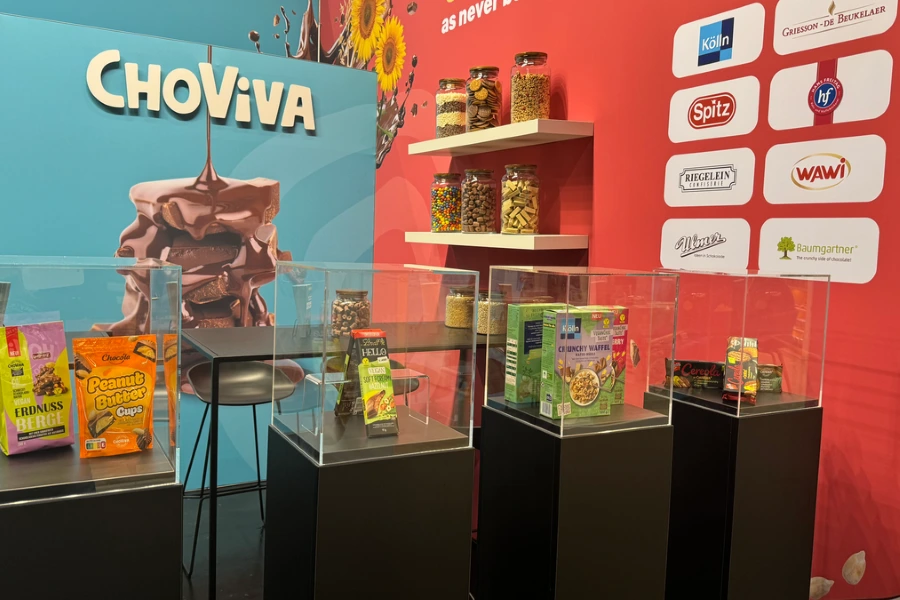 Planet A Foods showcases the ChoViva chocolate alternative at its ISM & ProSweets 2026 booth.
Coexistence, not replacement
Both companies emphasize that alternatives are designed to complement rather than replace traditional chocolate. Planet A Foods’ Marquart draws an analogy to wine.
“We aren’t looking to replace chocolate — we love chocolate,” he says. “But due to current supply challenges, high-quality cocoa is likely to be available more as a premium luxury product in the future, much like a fine wine. For everyday items like cereal, biscuits, or chocolate bars, it makes sense to use local alternatives when the taste and price are convincing.”
Cargill’s Mertens-Hoyng frames the shift as systems-based innovation. “The most important shift is that confectionery innovation is becoming systems-based. It’s no longer about single ingredient swaps, but combining formulation tools, sensory science, and processing expertise to protect indulgence under new constraints,” she says. “In an increasingly volatile environment, that flexibility is becoming just as valuable as indulgence itself.”
Trends at ISM & ProSweets 2026
Mertens-Hoyng identifies three converging trends visible across the trade show. First is cost-effective indulgence — solutions that help brands protect sensory appeal while navigating cocoa and sugar volatility. Second is credible sugar reduction, particularly in gummies, jellies, and hard candies, where flavor design, color intensity, and texture preserve sweetness perception.
Third is resilience-driven innovation. “Manufacturers are increasingly looking for flexible ingredient strategies — including cocoa optimization and alternatives — that allow them to adapt as markets shift,” she says. “This includes a greater focus on matching ingredient choices to specific consumption occasions, rather than applying a single solution across entire portfolios.”
The fair’s new Functional Sweets area is spotlighting products combining health benefits with indulgence, while the Start-up Area in Lab5 offers a window into emerging innovation. New country pavilions from Albania, Bangladesh, Iran, and Luxembourg have joined returning exhibitors, including Japan’s Morinaga, which has significantly expanded its stand following its 2025 debut.
For an industry still processing the aftershocks of 2024’s price spike, ISM & ProSweets 2026 is offering a first look at what the new normal might look like — a hybrid world where cocoa and cocoa-free alternatives work together to meet consumer demand.
With additional reporting by Joshua Poole at ISM & ProSweets 2026 in Cologne, Germany