

Interpack 2026 live: Bühler Group debuts energy-saving chocolate and bakery systems


Key takeaways
- Bühler Group is introducing upgraded chocolate and bakery processing equipment at Interpack 2026 that integrates AI and hygienic design to increase production yields.
- New roasting and mixing systems cut energy use by up to 30% while increasing throughput and speed.
- Modular lines allow for faster equipment swaps and reduce cleaning downtime by up to 70%.
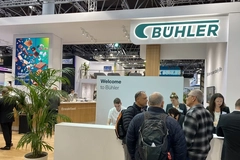
Bühler Group is exhibiting its new and improved food processing solutions in chocolate and bakery at Interpack 2026 in Düsseldorf, Germany (May 7–13) to address common pressure points in the global FMCG market shaped by a wide variety of product variants, seasonal demand impulses, and shorter innovation cycles.
The Swiss F&B manufacturing specialist has made various upgrades to its systems and introduced new processes in chocolate roasting and mixing, as well as in biscuit and cracker baking, to ensure consistency and boost production yield.
The new tools leverage the latest findings in hygienic design, usability, and digital solutions, including AI.
Bühler’s Chocolate Business Unit is presenting key advancements across chocolate mass processing: The Finer S Edition 26 five-roll refiner and the ELK S Edition 26 single-shaft conche. These latest editions are designed to offer improvements in areas such as cleanliness, usability, transparency, and efficiency.
“We have improved the Finer S on so many aspects — on usability, maintenance, hygiene design. So we have a completely new operating interphase on it. It’s highly intuitive, easy to onboard, within just about an hour or so,” Skeli Nesimi, head of product management, Chocolate & Flavor Creation at Bühler, tells Food Ingredients First.
“And I would really like to mention that we’ve been building refiners for more than a century. So all this knowhow has gone into these systems based on customer feedback and also new technologies. We have a smart control system in the machine that automatically makes the finest controls when adjusting itself.”
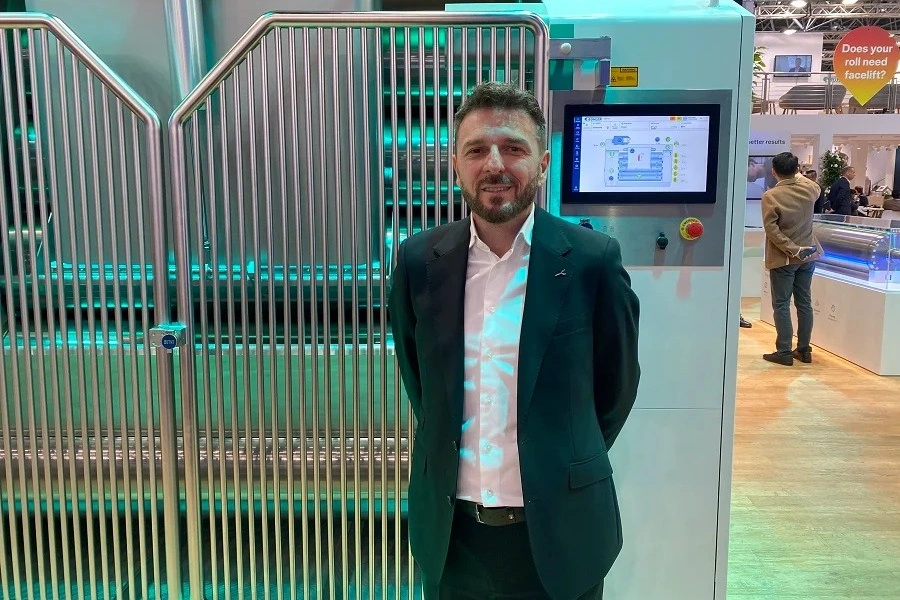 Skeli Nesimi, head of roduct management, Chocolate & Flavor Creation at Bühler, at Interpack 2026.Bühler is also introducing an upgraded version of the ELK S Edition 26 single-shaft conche, designed to support flavor development and process consistency in chocolate mass production.
“We have refined several elements of the machine to make day-to-day operation and servicing more straightforward,” says Nesimi. “The latest edition includes a new automation system and further developments aimed at hygiene, maintenance, and overall production efficiency.”
New cocoa roaster
Bühler has also introduced a new cocoa roaster, Lucent, which helps industrial-scale cocoa processors improve efficiency, reliability, and food safety. Compared with its predecessor, the Tornado roaster, Lucent uses at least 20% less energy per batch of cocoa and delivers up to 20% higher throughput, while minimizing yield loss.
The machine’s stainless steel, easy-to-clean design and fully sealed product flow ensure high hygiene standards and safe food production, Bühler details.
Lucent is also designed for effortless operation, with predictive, self-learning controls that help customers achieve consistent roasting results without requiring deep machine expertise.
Shear mixing
In other showcases, CompactMix, which was launched in 2025, brings together Bühler’s proven ShearMix mixing system with a spiral agitator for fast, uniform mixing, and the Aurora ball mill for grinding.
The system delivers uniform textures with particle sizes below 20 microns, resulting in a smooth mouthfeel. It also handles low-fat to high-fat recipes, giving producers full flexibility in chocolate mass production while consuming up to 30% less energy than conventional models, according to Bühler.
Additionally, CompactMix enables fast product changeovers with minimal waste and cleaning time under two hours. Its hygienic, fully enclosed design supports global food safety standards, and its modular scalability — from 400 kg/h to 3,000 kg/h — makes it suitable for both small-scale and industrial production.
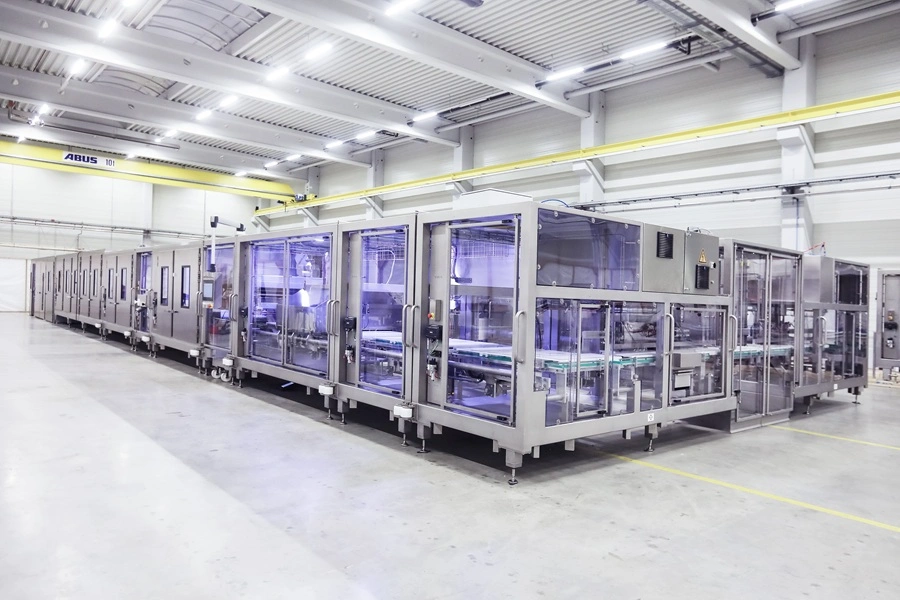 Bühler’s modular chocolate moulding line ChocoX can manufacture various products on a single line, including solid and filled chocolate bars, pralines, and aerated products.Meanwhile, Bühler’s next-generation modular chocolate molding line, ChocoX, enters when the chocolate mass is ready to settle in its final form. Highlighted as a flexible system that can be adapted to changing market requirements, ChocoX can produce a wide range of products on a single line – from solid and filled chocolate bars and pralines to one-shot applications and aerated products.
“The moulding line can be expanded step by step and easily configured to a growing product portfolio,” says András Somfai, head of product management, Confectionery, at Bühler.
“No more cost and time-intensive line modifications. Modules can be added or exchanged within 30 minutes, while the automation system automatically detects new line setups. This shortens the introduction of new products significantly, reducing time-to-market for new products by four to five months.”
Bakery and confectionery production
Bühler is also expanding its Smartline portfolio with the RotaMold Max Smart rotary molder and TurbuBake Smart tunnel oven.
The RotaMold Max Smart supports line speeds up to 40 m/min. Its 390 mm die roller ensures consistent biscuit sizing with a 1% or less coefficient of variation. The hopper, die roller, and knife are designed for easy removal to improve cleaning and maintenance efficiency.
The TurbuBake Smart gas IFC (Impact Flow Control) tunnel oven reduces energy consumption by up to 15% through an optimized heating and airflow concept. Its standardized design lowers complexity and total cost, while an intuitive human-machine-interface and updated baking chamber improve accessibility and operation.
SoftDrop is a cost-competitive system for depositing, wire-cutting, and extruding. It handles products ranging from muffins and meringues to fillings and decorations. Its lightweight pumphouse and roll-on/roll-off feature simplify handling in flexible production environments.
“SoftDrop further broadens our offering with a versatile solution for soft mass depositing,” says Céline Vachet, head of Product Management Biscuit at Bühler.
Bühler is also highlighting OptiBake, an inductive wafer oven that reduces energy consumption by up to 50% compared to gas-heated systems. It enables a baking process with no direct CO₂ emissions and offers precise temperature regulation for consistent wafer sheet quality.




Upcoming webinars

Oat-Standing Ingredients - Showcasing Irish Grain Through Innovation
Tirlán Ingredients

2027 Food Safety Risks for Quality & Compliance Leaders
FoodChain ID

Formulating for function: Developing benefit-led beverages with natural colours, botanicals, and flavours
Givaudan Sense Colour