



“A very good time to invest”: Cellular agriculture ramps up for landmark year in Europe
Cultivated duck cells near the end of EFSA’s safety assessment while pet food and personal care provide stepping stones to nascent companies

Key takeaways
- Parima can now produce avian cells on a ton-scale, and ship huge sample quantities to food manufacturers.
- Mewery CEO urges “a last push” in cultivated protein funding.
- With private investment down 95%, survivors share infrastructure and know how to stay lean.
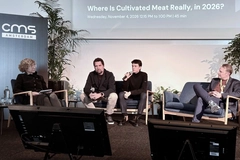 Left to right: Moderator Jo Anne Shatkin, president, Vireo Advisors; Roman Lauš, founder and CEO, Mewery; Nicolas Morin-Forest, CEO, Parima; Sebastian Rakers, CEO, Bluu Seafood.
The cultivated meat industry is holding its ground in Europe, despite outright bans in Italy and Hungary, collapsed private investment, and high-profile closures like Meatable and Believer Meats.
As 2027 nears, companies in the space are watching for the European Food Safety Authority’s (EFSA) first scientific opinion on cultivated animal biomass, which could come as early as Q1 next year.
The French cultivated protein company Parima, which formed through Gourmey’s acquisition of Vital Meat, is nearing the end of EFSA’s safety assessment for a novel food. The company’s application covers cultivated duck biomass for use in products like slaughter-free foie gras and pâté. This April, the company received regulatory clearance to sell its cultivated duck cells in Singapore.
Parima is not the only one waiting for novel food authorization. Dutch producer Mosa Meat submitted a dossier for cultivated beef fat in January 2025, the second cultivated product to enter the EU novel food process.
“The industry has moved tremendously,” said Parima CEO Nicolas Morin-Forest at the Cultured Meat Symposium (CMS), held November 4–5, 2026, in Amsterdam, co-located with The Future of Protein Production (FPP).
“Over the last seven years, we moved from producing grams to kilos to hundreds of kilos, and now we are at ton-scale at a price that makes sense and tastes great. We have onboarded Michelin-star chefs who are now vetting our products,” he said.
“We have proved the technology and the cost — now it is time to win over the consumer.”
Part of that, he said, is calling the ingredient what it is: a cultivated biomass or protein, rather than “meat,” a word that carries its own charged perceptions. Ivy Farm Technologies has received UK approval for its cultivated Wagyu beef as a pet food ingredient, but maintains that human food is its ultimate target demographic.
Proving the pathway
One way companies are warming up consumers and regulators to the idea of cultivated animal cells is through the pet nutrition industry.
At this year’s Future of Protein Production event, Ivy Farm Technologies announced UK approval for its cultivated Wagyu beef as a pet food ingredient.
“Our cultivated Wagyu has a great flavor and nutritional value, and ultimately our priority is to develop a product for human food,” says David Pytches, head of sales at Ivy Farm.
Entering the pet food market will allow the company to scale and bring prices down. Ivy Farm’s product adds to the list of approved animal cells for pet food in the UK.
At last year’s FPP event, Meatly CEO Owen Ensor pointed out that pet owners are, by nature, animal lovers, which could make them exceptionally open to slaughter-free food. The regulatory pathway is also more favorable.
Meatly’s cultivated chicken cells are already in products on the market in the UK. In 2027, the company expects to scale up further to reach continuous production.
The personal care sector is also a market entry point for cultivated products. Sebastian Rakers, CEO of Bluu Seafood, told CMS attendees that his company’s cultivated fish cells were found to produce high-value side streams.
“The cells produce a lot of different metabolites, more than 4,000, and a few hundred of these are relevant for personal care,” he said.
His company identified polydeoxyribonucleotide (PDRN), a “performance-driven” ingredient popularized first in Korea for skin care.
Rakers said that commercializing personal care ingredients first can help the company sustain itself during the long path toward food production.
“We are a VC (venture capital)-based company, and as long as we don’t have revenue coming in, we are dependent on investors believing in us. So, getting products into the market right away, even if it’s not in food, is vital.” Bluu identified the high-value longevity ingredient PDRN as a metabolite produced during its cell cultivation process. The ingredient has applications in skin care.
Getting resourceful
Global private investment in cultivated protein plummeted by 95% from its 2021 peak of US$1.5 billion to around US$75 million in 2025, according to Good Food Institute figures.
With only 5% of the private investment it once had, the sector has become more resourceful out of sheer necessity.
“In times of scarcity, you need to innovate,” said Roman Lauš, CEO of Mewery, based in the Czech Republic. Mewery is developing a protein biomass platform combining animal cells and microalgae.
“There are companies out there that raised hundreds of millions of dollars for their projects, but we are scaling up with only 4 million euros raised. There is no more time [for investors] to build amazing factories with no customers.”
The downturn has led many to say the sector is doomed to fail, including Meatable’s former CEO in an interview with Food Ingredients First.
A last push
For Alex Crisp, novel foods consultant and program director for the CMS, the sector is almost there.
“The research is done. The tech is done. Company valuations are down. The need is undeniable. Pets are eating it,” he said.
“As soon as a product is approved and finished, it will likely be the big food companies that pick up where early investors gave up. “
Morin-Forest pointed out that there’s been a huge mismatch in timing between VC expectations and the technological development: “Five or six years ago VC excitement was extremely high, and the space was nowhere. Now it’s completely the opposite. We [Parima] are at the stage where we can ship samples of 50 kg to large food manufacturers. And this is the type of progress that has not been factored in yet by the VC community.”
That mismatch in timing is unfortunate, said Lauš.
“It’s a pity there is no funding for many of these companies because they don’t need much. They went through incredible obstacles to make it to this moment. They need a last push.”
Better value for investors?
When asked if now was the time to invest in cultivated protein, John-Felipe Murphy, scale-up and regulation manager at Imperial College London’s Bezos Centre for Sustainable Protein, told Food Ingredients First that investors can get more value for their dollars now if they come across a good opportunity.
“Some companies can now produce biomass that they lacked even two years ago. The real challenge is that investors might struggle to find other investors to co-invest with them, because the market overall is down,” he said, pointing to investment attention going to AI.
 Parima's collaboration with Vow in Australia allowed it to produce its flagship biomass in the tons.Still, others at the symposium argued that AI is becoming too expensive and that there is a renewed interest in deep-tech businesses sweeping Silicon Valley — tech that leads to tangible products, like food biotech.
“It’s a very good time to invest because the companies who have survived are the most resilient,” added Lauš in a conference session.
These companies are also more resourceful than ever. Less funding pushed companies into collaborations that would once have been unthinkable.
For years, the industry talked about working together but kept its secrets closely guarded, Lauš explained
“Now people say what they do because we need each other to bring this product to market. Until we are on the same Tesco shelf next to each other, we are all friends.”
Banding together
A clear example of collaboration is Parima’s success in producing more than two metric tons of finished-product equivalent in April 2026, which was done through a partnership with Australian peer company Vow.
Morin-Forest said that the change in the funding environment was the catalyst for companies to share infrastructure, so they don’t have to build their own.
“A few years ago, it was more how many dollars do you need to build that big facility, and today it’s more how many dollars do you need so you don’t need any more dollars. In other words, how can you become self-sufficient.”
Morin-Forest said that Parima adapted to less funding by refining the way it produces the cells.
“Our processes are plug and play to very standard equipment, and we are very happy to see more and more open access facilities emerging. The more we can homogenize our processes so that we can use similar manufacturing lines, the less money we will need to become profitable.”
Murphy from the Bezos Centre added that shared manufacturing infrastructure could also help companies generate regulatory evidence more efficiently.
Regulation as the last hurdle
In the meantime, philanthropy is picking up some of the slack that VCs left behind. Anna Handschuh founded the Ministry of Future Affairs, a philanthropically funded organization dedicated to securing the future of food in Europe.
“The Ministry of Future Affairs is, of course, not a ministry, but we need one, so we created one,” she said.
The organization helps novel food producers improve the quality of their dossiers, because “they are not always as great as they should be.”
“We also know that very good dossiers go through the process significantly faster,” she added.
As part of its outreach, the Ministry of Future Affairs will hold a free regulatory workshop called The New Foods RegLab in Brussels in January 2027 for up to ten companies applying for novel food authorization. Applications close November 30, 2026.
The workshop is run in collaboration with Atova Regulatory Consulting, the consultancy that worked with Parima on its dossier.
For this budding industry, the first regulatory approval in Europe could be the critical turning point. Industry eyes will be watching in 2027 as EFSA issues its opinion and sends it to the European Commission for authorization by a vote among member states.