



Penn State scientist: Human oversight must evolve as AI speeds food R&D

Key takeaways
- Penn State’s AgentXtract tool uses AI to turn scientific papers into structured food property databases for R&D.
- The AI agent collected more than 4,000 data records in about 30 minutes, potentially cutting weeks from early-stage R&D.
- Researchers see applications in process optimization, food safety, and human-AI research workflows.
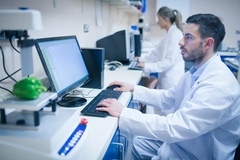 Food scientists are increasingly combining experimental work with AI-assisted analysis.
Information on food properties that affect quality, sensory performance, and safety is crucial for NPD and increasingly for training AI models as digital tools become embedded in food and beverage R&D workflows. However, most data is “scattered in literature,” making the development of food property databases time-consuming and difficult to scale, according to The Pennsylvania State University, US.
Researchers at the university have developed AgentXtract — a tool combining human expertise and AI — to automatically transform scientific papers into databases that could help scientists overcome these challenges.
Food engineers provide the expertise needed to identify scientific data sources and ensure data quality and reliability, while AI handles large-scale data collection.
Study lead and assistant professor of food science at Penn State, Xu Zhou, tells Food Ingredients First that the biggest opportunities for the “agentic AI workflow” lie in food process optimization.
“Our approach can collect experimental data from decades of scientific papers and build large, reliable databases. We can then use this data to train AI and machine learning models to predict food properties under different conditions.”
For F&B manufacturers, these databases could support predictive modeling and process optimization while reducing reliance on extensive experimental testing.
“The same approach could also work for other food properties, such as microbial growth and inactivation, chemical reaction kinetics, and sensory properties. Depending on the data, it could help improve food safety, shelf life prediction, and product quality,” says Zhou.
The team’s findings are available online ahead of full publication in the March 2027 issue of the Journal of Food Engineering.
Speeding up food R&D
AgentXtract could help food manufacturers reduce the time spent on the early stages of R&D, when scientists often spend days or weeks identifying relevant studies, extracting experimental data, and assessing its reliability, Zhou explains.
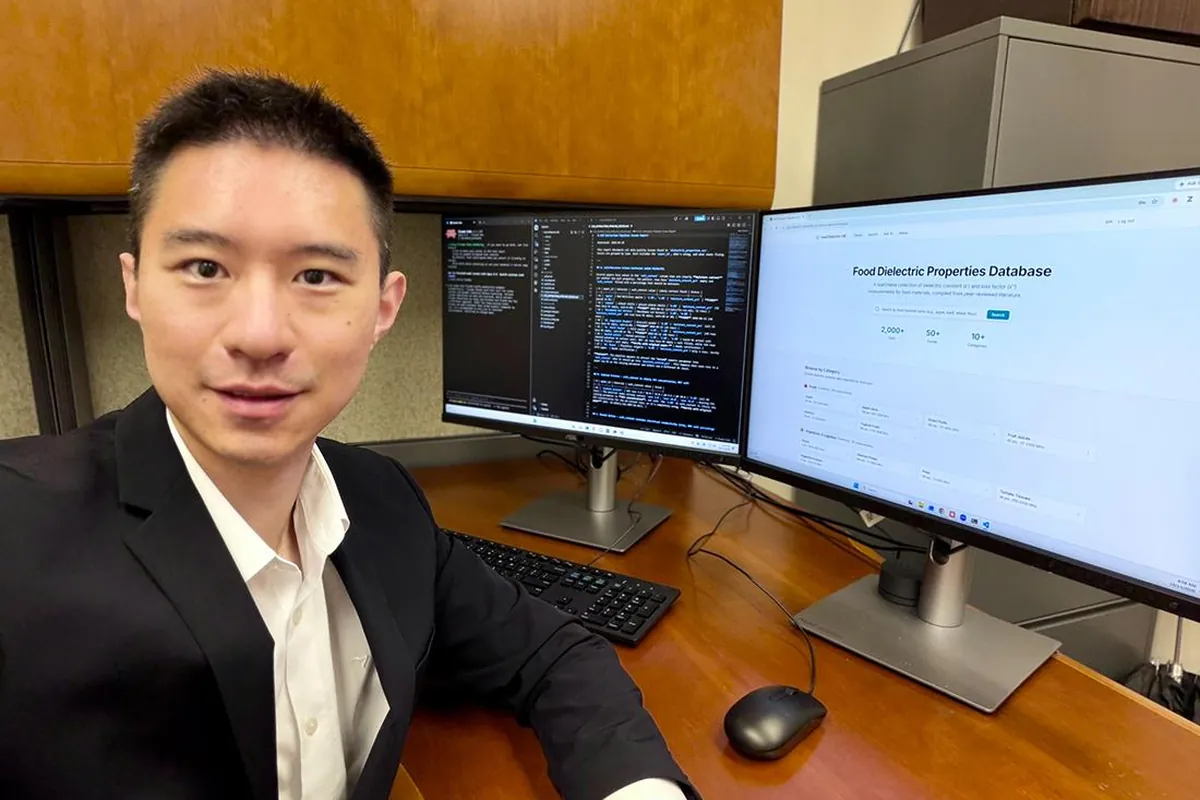 Xu Zhou led the team that developed AgentXtract, displayed on the computer in his office (Image credit: Penn State. Creative Commons).“In our study, the AI collected more than 4,000 data records in about 30 minutes. Doing the same work manually could take weeks.”
Automating this process could allow R&D teams to move faster from literature review to modeling, experimentation, and product development.
Zhou says the approach could be particularly valuable for processing challenges that are difficult or costly to investigate experimentally. He cites microwave heating as one example, as the interaction between microwaves and food depends on factors including dielectric properties, composition, shape, and processing conditions.
“The factors determine how microwave energy is absorbed and converted into heat, which directly affects food safety and quality.”
Testing every possible combination of formulation, packaging, and processing conditions can be difficult and expensive. By making reliable food-property data easier to access, AgentXtract could support computer simulations that allow manufacturers to “evaluate different options before conducting experiments.”
AI for process optimization
Zhou expects the earliest adopters of AgentXtract to be food and ingredient companies already using computer simulations and predictive models in their R&D routines.
“Companies using microwave or radio frequency heating for pasteurization, sterilization, or drying need reliable food property data to design and improve their processes. Ingredient suppliers and food companies with established R&D teams could also benefit.”
For these businesses, access to larger and more reliable scientific databases could help them develop new products and improve their manufacturing processes.
However, Zhou stresses that AI-generated databases and computer simulations are not a substitute for experimental validation. These simulations still depend on accurate dielectric property data.
“Our approach makes that data easier to access, which could help improve computer simulations and process design. Of course, we still need experiments to confirm the results.”
Unlocking AI-driven food discovery
For companies using AI agents like AgentXtract, Zhou points to two major opportunities in food manufacturing.
“The first is scientific discovery. In our study, we used AI to collect dielectric property data published over several decades. When we analyzed the database, we found physical relationships that had not been reported before. These relationships were difficult to see when the data were spread among many individual papers.”
 Food property data can help engineers understand how products respond to different heating and processing conditions.Describing this approach as “exciting,” he says similar methods could help scientists discover new relationships in other areas of food science and develop better understanding or models.
“The second opportunity is making scientific knowledge easier to access. We can use these databases as knowledge bases for AI assistants. So when a food engineer asks a technical question, the AI can find relevant experimental data and scientific references to support its answer.”
Together, these prospects could broaden AI’s role in tackling practical food engineering challenges, including testing protocols and process parameters.
Across the food industry, AI is already being used to screen plant proteins for functional properties, support faster formulation decisions, and improve the taste and texture of sustainable proteins.
Rethinking human-AI collaboration
As AI becomes more capable, researchers need to rethink how humans and AI work, Zhou notes.
“The traditional approach is that AI does the work, and humans check the results. But AI is developing so fast since early 2026 that humans may actually become the bottleneck if we still need to check every step.”
Zhou explains this with a personal example: “I often work with multiple AI agents, and sometimes they complete tasks much faster than I can review the results or provide the next instructions. As AI takes on more complex tasks, it becomes increasingly difficult for humans to review every detail in a reasonable amount of time.”
“This raises an important question — how can we maintain scientific rigor and reliability without slowing down the benefits AI can offer?”
Food scientists might need a different approach in the future, he emphasizes.
“Scientists can focus more on defining research questions, setting goals, and making important decisions. AI agents can take on more of the research process, and other AI agents can help verify their work through independent tests and checks based on scientific principles.”
Despite AI taking on more of the research process, Zhou stresses that human oversight and experimental validation would remain essential.
Humans would still “oversee the process, evaluate important findings, and use experiments to confirm new discoveries.” This is especially important before applying them to real manufacturing decisions.
“The goal is not to reduce scientific rigor or remove humans from research. It is to find better ways to use the strengths of both AI and human scientists so we can solve problems that were previously impossible to address.”