
- Industry news
Industry news
- Category news
Category news
- Reports
- Key trends
- Multimedia
Multimedia
- Journal
- Events
- Suppliers
- Home
- Industry news
Industry news
- Category news
Category news
- Reports
- Key trends
- Multimedia
Multimedia
- Events
- Suppliers
Tech demo: Givaudan’s aroma synthesizer and algorithms slash flavor development time
05 Oct 2023 | Givaudan
Now in its fourth generation, Givaudan’s Virtual Aroma Synthesizer (VAS) can help customers attain nearly finished flavors in a matter of hours rather than weeks or months. Santiago Vega, VP of marketing for Givaudan North America, explains how the technology is bringing products to market faster. Kim Juelg, principal flavorist and co-creation technical manager, demonstrates how the VAS works at IFT FIRST 2023 in Chicago, US.
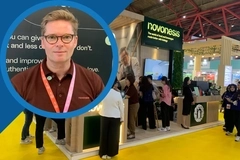
This is Missy Green at IFT 2023.
I'm here with Santiago Vega, who's the VP of marketing for Givion North America.
So Santiago, what are you featuring here today at the show?
So there are a few things that we're showcasing this time.
Perhaps the most important one is our, digital and AI enabled, innovation technologies, what we call our bath, our, virtual aroma synthesizer, and essentially what this does is AI assisted technology.
That significantly reduce the development cycle for customers, for developers, and really ultimately gets to speed to market for them.
So essentially what we're able to do is with our proprietary technology is to convert from aroma to flavor and translate from aroma to flavor in a way that allows developers to identify the aroma notes that they like into a certain application.
For instance, here we're showcasing their alternative milks and.
We're showing how you can incorporate this technology to fine tune the flavor selection process and ultimately get you to a an iterate reducing the iteration of of trial and error that normally goes in a flavor selection process.
So what we're showing is kind of oat milk and then we can mask it if you want to neutralize all aromas, and then we'll build a flavor on top of it.
I'm Kim Joo, principal flavors for Chevron and been with Chevron for 28 years, and I'm a huge.
User of this tool we developed this in-house, probably 25+ years ago.
First one was big gigantic tabletop, little small jars, definitely not portable, and then this is now 4th generation, so it's smaller and it's portable and so we can easily bring it to you or work wherever we need to work, but the beauty is not necessarily just the hardware.
There's actually a software algorithm behind this that takes what you create.
And we send it to my formulation editor, and it will take the smell to taste algorithm into effect.
And it's based on like the partition coefficients of molecules, but to try to describe it, say we're working with like heavy lactone molecules that aren't very volatile, I might have to increase those up high enough to smell as we create, but when we send it back through our formulation editor, it will drop those down to be at a level that makes sense, when you taste it.
So.
Physically how it works, I've got cartridges in here that we can load with finished flavors and keys, and when I say keys, I'm talking like one molecule to like 3 molecules where full finished flavors are 30 to maybe 60 or 70 molecules, so they have all of the complexity.
So as we work and say we're going to create a caramel flavor, we would want full build caramel flavors on here and then keys.
There's 30 keys in here and I kind of call it a piano.
So I can play one key at a time.
I can play all 30 at a time.
I can play it loudly or I can play it softly.
So air will flow outside, come in this mixing column, and then you're gonna sniff right here.
So you would just kind of bend in when it comes time to sniff.
And you'll see here we also have base jars.
So if your base has aroma, we will actually put bass in it and then you'll be able to smell that and create a flavor on top of that base, which will give you the impression of how that flavor.
Flavor will be perceived on your base.
The demo I have on here is actually oat milk today because we actually can do masking work as.
So say you've got a plant-based milk and wanna kind of neutralize the plant-based notes.
We've got maskers.
As long as it's volatile, we can do that on the bass.
If you're looking at like a stringency masking, bitter masking, or like sweet tools, those are non-volatiles, we'll have to do those by, by taste.
And we're gonna smell through each channel and describe it.
So if we're working on caramel.
You're going to go through each one and you might say, I hate #1, I don't like it at all.
Number 2, I like the buttery notes it has.
3, I like the back end, and maybe 4, you like the front end.
And then we're gonna smell through each key, which again is like 1 to 3 molecules, and kind of describe those who understand what those are before we start blending them.
So, I'm gonna put this first caramel on so you guys can come up with the smell.
You can have your own nose piece if you want, or you can share.
OK, and then I'm gonna put a 2nd caramel flavor on.
So go ahead and smell that one and tell me if they're different enough for you.
Pretty different, OK.
So say you liked the first one better, but you like this one a little bit.
So I'm gonna lower the 2nd 1 and then come back and add.
The first one in to combine it, so you can go ahead and smell that.
OK.
And then if you want to stay smelling, I'm just gonna increase one of them again and show you just how quick it, it changes.
OK.
So did you like one or 2 better?
OK, so I'm gonna increase 1.
OK.
So go ahead and smell it where it's at, and then I'm gonna double that.
So it went pretty quick.
So it's pretty quick as you can see it just goes in real time.
And the nice thing too is, so say you're working on caramel.
Oh gosh, how would that green grassy note work?
I don't know.
Let's just try it because it's so easy on this.
If you don't like it, we just zero it down again and move on.
So as we would create, say we're working through caramel, we would go ahead and save memories as we go.
So for instance, I've got these memories saved up here on the oat milk demo, so we might get to the standpoint where we've saved 5 or 6 different caramel flavors, and then let's go back through and smell all of them again now that you've created them.
Are there any you wanna kick out, and you wanna move forward with, and then from there we can put them together in one flavor for you, and send them back to you.
I typically say we can do one flavor per hour.
So say you wanted to do caramel, peach, and strawberry.
We could come to you, you could come to us, and we would do one about an hour.
So we could do basically 3 flavor development concepts in an afternoon.
The beauty of this being portable is we can come to your location, and the benefit of that is, instead of coming to our location, which is nice because we do have a full complement of support people in the labs that are, ready to work on stuff and turn it around, but a lot of times what happens is one or two developers come and then they get back to home base when they're done and then marketing.
Says, you know, I'm not sure that's really the direction we want to go, and so they maybe have to pivot or do some changes on it.
So in this case, we've included how we demonstrated how the technology works in several applications and perhaps the most obvious one is in dairy and dairy alternatives.
But it could really work across an entire set of possibilities in sweet, savory beverages, etc.
It definitely speeds stuff up versus the I compound something, send it to you, get comments, make a revision, so weeks to months goes down to like a day.