
- Industry news
Industry news
- Category news
Category news
- Reports
- Key trends
- Multimedia
Multimedia
- Journal
- Events
- Suppliers
Suppliers
- Home
- Industry news
Industry news
- Category news
Category news
- Reports
- Key trends
- Multimedia
Multimedia
- Events
- Suppliers
Suppliers
Jake Kirkendall, a scientist for hops and brew innovation at Kalsec, examines what technologies are driving the beverage space and how consumers are increasingly ditching artificial fruity flavors to seek a more authentic beverage experience. He also dives into Kalsec’s developments, including a beer with underlying floral and crusty bread notes with coriander and orange peel as well as food waste-tackling solutions.
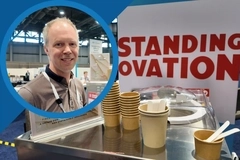
This is Josh report reporting Drinks Tech 2022.
I'm here at the Calex lab with Jake Kirkendel, who is a scientist for Hops and Brewing Innovation.
Welcome to you.
So if you start with a general question, what technologies are driving the beverage space right now?
So right now we're seeing a lot of differentiation.
Folks are looking for healthier options.
They're looking for, different options in terms of functionality, and I think we're.
We're moving more towards a space where a lot of the fruity artificial flavors of the past are not quite satisfying customers and that they're looking for things that are more authentic and create a more authentic beverage experience.
OK, I understand today you're presenting a Calsec Wickfit, a weakness whit beer with underlying floral and crusty bread notes with coriander and orange peel.
What more can you tell us about his innovation?
So with the quick wit we brewed a traditional Pilsner style beer and we started with adding a little bit of kettle extract.
So this is a custom kettle extract that Calsec makes by separating out the hop oils, fractionating them, and then recombining them with the hard resin fraction.
So we do that to get a little bit of base hop character and then.
We've added our our whip beer type as as our blood orange character to be able to take a Pilsner beer and differentiate it and take one work stream and taking a base pilsner, making it into something that's completely different.
That's very interesting and obviously reducing waste is a key industry issue.
I also understand you're presenting looplock encapsulated hop oils which enable brewers to accelerate production and reduce waste.
Yeah, how exactly does this work?
So, loopullock is a market first encapsulated hop oil, and one of the problems with dry hopping is there's lots and lots of waste.
So hops soak up 10 times their own weight in beer.
And so that creates a lot of waste downstream.
So what we've done is we've designed some hop oil fractions that give that nice clean dry hop aroma, and then we've encapsulated them in a maltodextrin matrix, and dosage rates on these are 1 to 2 g per hectolitre, replacing 1 to 1.5 kg per hectolitre of dry hops.
One of the other nice things about the.
It's a lot more stable and so it's creating less waste in the end in terms of hops that may go bad in the brewery and stale over time.
OK, that's brilliant.
And as a final question, hard seltzers are also continuing to be a big trend.
What's the company doing in this space?
So I think with hard seltzers, the big thing right now is what's new, what's different.
There's not a hard seltzer brand where there's a drinker of, you know, let's say Black Cherry White Claw.
It's a good product, but people aren't brand loyal to hard seltzer in the same way they are for beer.
So bringing things new and different into the industry and especially I think the next trend is going to be authentic flavors and moving more towards cocktail type flavors.
So introducing things like wormwood and cilantro and really trying to stick out in the marketplace.
That's great, Jake.
Thanks for your time.
Thank you.