

- Industry news
Industry news
- Category news
Category news
- Reports
- Key trends
- Multimedia
- Journal
- Events
- Suppliers
- Home
- Industry news
Industry news
- Category news
Category news
- Reports
- Key trends
- Multimedia
- Events
- Suppliers
FiE 2024: Cosun Protein propels plant-based innovation with functional fava beans
22 Nov 2024 | Cosun Protein
Michiel Pronk outlines why fava beans are an optimal ingredient for plant-based alternatives and how the company is tapping into solutions made from the high-protein crop. He details the surge in demand for alternative proteins and how fava beans' functionality and milder taste profile offer vast innovation opportunities.
So Fenrista reporting from FAE 2024 in Frankfurt, Germany.
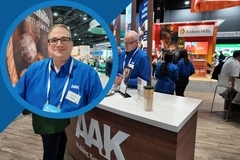
I'm here at the Kos and protein stand with Michel Frank, who is the sales manager.
Welcome to you.
Thank you, Josh.
Excited to be here again.
Great.
So Kosten protein is known for its fava bean solutions.
Why are fava beans an optimal ingredient for plant-based alternatives?
I think there's multiple angles you can you can look at it.
In general, you see that there is a search for alternative plant-based proteins.
I think with fava bean having a more milder taste profile in general, especially the way we extract the proteins from the fava beans, it comes also with some functionalities.
So the combination of functionality and milder taste profile of the proteins, I think that offers quite some opportunities in a wide range of applications.
And today you're showcasing your tender solution.
About this solution, what are the end market applications for it?
Sondra, as I said, dandra is a mild extracted protein.
It comes with a neutral taste profile.
Also functionalities like high solubility, emulsification capabilities.
So we focus on those applications where you really need those those properties.
So where you want to have neutral taste, where you want to have the.
Functionality.
So initially we started with dairy and non-dairy applications, so we've been quite successful there.
So think about plant-based yogurts, plant-based eye cream, but we now see that also widening up.
So we also see now sports nutrition coming up, even like meat applications are also entering our focus area.
And consumers are increasingly concerned about the nutritional quality of their food.
To what extent does tendra facilitate healthy alternatives to meat?
I think that's a good question.
I want to focus a little bit more on the wider range, not per se on meat.
I think if you look at plant-based formulations in the supermarket today, I think nutrition nutrition-wise, there are challenges.
They are lacking protein content, for example.
What tanra offers is that due to its properties, the high solubility, the neutral taste.
It offers to increase levels of proteins in your formulation.
So I think in general what we see from our customers is that with tendra they are able to increase protein levels in formulations, plant-based formulations.
So I think that's a benefit nutrition-wise over the whole whole set of applications out there.
Environmental sustainability also remains top of mind for many consumers.
In what way is this tender and eco-friendly option?
Tundra has already regrown because of its high protein content for the for the feed side of the industry.
Besides that, fava beans also are a very sustainable crop from a nitrogen point of view.
Fava beans take nitrogen from the atmosphere and they put it back in the soil.
So also for our farmers, it's a very, very sustainable crop to add in that crop rotation.
So from that point of view, so looking at it from a yield point of view, but also from that environment.
Point of view, I think fava beans are a very sustainable crop for the future.
And as a final question, how do you see the plant-based space evolving over the next 5 years or so?
Very good question, Jo.
Interesting question.
Personally, I think what you see is that if I look, for example, I'm from the Benelux, from the Netherlands, you see a lot of challenges with getting the protein transition started.
Going from 40 to 60 to 60 to 14 protein range.
So I believe, for example, also in hybrids.
So you see that the plant-based formulations in the supermarket are maybe stretched out already.
So personally I see hybrid as a next step to really kick that protein transition off and that's also what we see talking with our Customers, so hybrid dairy application, hybrid meat application.
So personally, to be able to really make that protein transition in the coming 5 to 10 years and also consumers are very sensible for taste and texture.
I see hybrid as a goal to make that transition happen.
That's brilliant.
Thanks for your time.
Enjoy the rest of the show.
Thank you, Josh.