


A banner featuring a sample box and dried vegetables
Home
Videos
Alvinesa replaces sy...

Alvinesa replaces synthetic antioxidants with upcycled grape and olive ingredients

05 Sep 2023 | Alvinesa

Spain-based Alvinesa is a 75-year-old company that recently found new ways to process biomass left over from the wine and olive oil industry. Working off 97% renewable energy, the company markets its products as natural and sustainable. Pelayo de las Cuevas Atienza, head of sales EMEA-LATAM, health and nutrition, explains how brands can leverage the ingredients for meat preservation and nutraceutical applications.
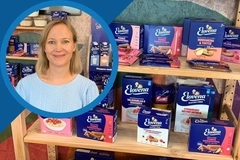

This is Missy Green with good ingredients first here at IFT 2023.

I'm here with Palayo de los Cuevas at Alvisa, and he is the head of sales.

So tell me, Palayo, what are you showcasing here today?

Hello, Missy.

Thanks for the opportunity.

My pleasure.

Alvinessa is a producer of, upcycled natural ingredients from, grape and.

Olive co-products.

So here we are showcasing our antioxidants and ingredients for the food and nutraceutical industry.

So what makes this ingredient unique?

First, there are upcycle ingredients 100% produced close to the source of the raw material which in our case is Spain.

Where we have the largest extension of wine vineyards and olive oil industry worldwide, so we're very close to the raw material.

We can have access to very fresh raw material and extract all the ingredients that that we do from this raw material basically.

We use no solvents to extract.

It is a 100% natural extraction.

The energy we use to produce our ingredients is self-produced at 97% through solar energy and biomass, our own biomass, so the products are really sustainable both as natural ingredients and as the way we produce them.

Is the biomass also from the wine industry?

It is, in fact, after producing all the ingredients that we extract from the grape pumas, the remaining biomass, we use it for our steam production.

So that makes us very independent in terms of energy sourcing, which is always interesting and sustainable both in terms of the environment and economically.

So is this a new company?

The company is 75 years old.

We've been doing the traditional business for many years, and a few years ago we developed the health and nutrition division where we developed these natural ingredients for the health and nutrition industry.

These are the colors.

The antioxidants, different kinds of extracts from grape and olive.

What was the trigger for that segue into nutraceutical applications?

Basically, the market is demanding natural ingredients and also access to products that are very traceable, and we have access to the raw material.

We are the largest producer of grape products.

So we have this big factory we built a new factory 9 years ago and we decided to go into the health and nutrition market because it was a big demand for natural products.

So this is actually what we do upcycle ingredients, natural ingredients, and very sustainable ingredients.

So we think that these three features are something that is interesting for the.

Natural ingredient market and we went for this opportunity.

So what kind of preservatives or synthetic ingredients could it replace?

Nitrates, nitrates, BH BHA, several synthetic antioxidants that they are being challenged in the industry.

I don't think it will be a direct substitution from one day to another one, but it's it's a trend towards the Parsons substitution and for more natural alternatives for the food industry, and this is where we think we can play a significant role.

And what kind of food applications?

I think there's some experience already in meat, but, all the application for drinks and for, generally for food stitive to synthetic antioxidants that are currently used in all the different supermarkets in the food industry.

OK, and, and it can be listed as a natural flavor.

It can be listed as a, as a, as a grape, concentrate grape concentrate.

OK.

I know you said the reg the regulatory question was complicated.

Yeah, this could be tricky because depending on the country we we have some experience in Europe where it's actually.

Listed as a grape concentrate or grape water concentrate, but then depending on the market, the regulatory could differ.

This is something a little bit more complex.

It's not a black or white.

It's part of the development.

Companies are looking for natural alternatives.

There are some products like the rosemary.

Or vitamin E, the topophroros, which are very established, and other ingredients that we are coming into the portfolio of natural alternatives and regulative has to be developed as.

So are there products now on the market that are processed meat that use your ingredient for a preservative?

Are they able to completely replace some of these synthetic, it is more complex because synthetic antioxidants, they've been in the market for decades, so this institution is not A4B.

Natural antioxidants, they can be synergetic to some synthetic.

Allow the reduction of the dosage of synthetic.

They can be synergic with other natural antioxidants, so it's quite a complex formulation that is required.

It's not a straightforward substitution.

Is this something that your company is investigating?

We are, we are collaborating with key leading companies in different subsectors of the food industry, and we are also developing our own information and data through our own studies.

Yes, we are doing both.

OK, thank you very much.

More videos

Image