




Future Food-Tech San Francisco 2026: How Tate & Lyle leverages AI for healthy ingredient innovation


Key takeaways
- Acquisition of CP Kelco strengthens Tate & Lyle’s capabilities in sweetening, mouthfeel, and reformulation across multiple food categories.
- AI, generative tools, and automation are accelerating ingredient development, improving speed, precision, and data-driven innovation.
- Focus on healthier, sustainable food solutions includes sugar reduction, clean label texturants, and scalable technologies that maintain taste and texture.
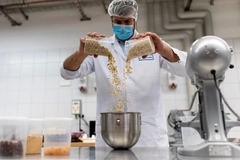
Following its acquisition of CP Kelco, Tate & Lyle has expanded its ability to tackle complex reformulation challenges across beverages and a wide range of food categories, including dairy, soups, sauces, dressings, bakery, and snacks.
In 2024, Tate & Lyle acquired CP Kelco, a leading provider of pectin, specialty gums, and other nature-based ingredients, to create a leader in mouthfeel, and significantly enhance its solutions capabilities.
Positioned as a global leader in sweetening and fortification, the combined business is strategically placed to keep pace with growing consumer demand for healthier, tastier, and more sustainable F&B.
We speak to Victoria Spadaro Grant, Tate & Lyle’s chief science and innovation officer, during Future Food-Tech 2026 (Mar 19-20) in San Francisco, US, to find out more about the growth potential of the new business, and how new technologies like AI and automation are reshaping ingredient development.
“Tate & Lyle continues to evolve its portfolio to help customers reformulate for lower-sugar, fat, and calories by combining expertise in sweetening, mouthfeel, and fortification. That means helping manufacturers improve the nutritional value of their products while protecting the taste, texture, and overall sensory experience that their customers love,” she says.
“The expansion of our scientific and innovation capabilities has enabled Tate & Lyle to be an even stronger solutions partner for healthier, tastier, and more sustainable food and drink.”
“In addition to scouting for technologies that align with our strategic focus areas, we also feel it is essential that our people take time to keep abreast of emerging technologies. We are particularly interested in technologies that can unlock better reformulation outcomes across our key end-market categories.”
That includes innovation in plant-based clean label texturants, emulsification solutions, gelling agents and stabilizers, taste modification, and ingredient solutions to help build back mouthfeel in lower-sugar and lower-fat products.
 Tate & Lyle highlights its innovation in stevia-based sweeteners, responding to growing consumer demand for natural, low-calorie alternatives without compromising on taste.
Data-driven ingredient development
Ultimately, Tate & Lyle seeks technologies that align with its purpose of “transforming lives through the science of food, with strong potential for scalability and global relevance,” notes Spadaro Grant.
Some examples include 1:1 sugar replacement solutions that can deliver functionality closer to sugar itself, and technologies that can enhance or augment sensory capabilities, helping the business solve more complex formulation challenges around taste, texture, and overall eating experience, which is in line with the company’s focus on combining sweetening, mouthfeel and fortification capabilities to deliver better customer solutions.
“We are also interested in process innovations that could enable more efficient or more sustainable production. That could include technologies that improve yields, reduce use of water and electricity, or enable beneficial use of waste streams,” Spadaro Grant tells us.
Last month, Tate & Lyle collaborated with a bioalternatives scale-up platform, Manus, to launch Yume M Stevia, a premium stevia-derived sweetener offering sugar-like taste under a new brand.
Leveraging digital formulation tools
Tate & Lyle has been strengthening how it captures, develops, and shares its scientific and technical knowledge within its organization.
“We see AI as a transformative technology in accelerating innovation,” says Spadaro Grant.
Tate & Lyle recently launched a new Generative AI tool within its Global Applications & Solutions Development team. This tool makes the company’s extensive proprietary scientific and technical knowledge easier to find, analyze, and apply, helping teams respond faster with insights.
“Furthermore, our Automated Laboratory for Ingredient Experimentation in Singapore, which we call ‘Alfie,’ is a first-of-its-kind robotics system supporting our scientists, helping them design starches faster and with greater accuracy.”
“Alfie runs tests at 10x speed and generates millions of data points, essentially making it a factory for starch data. In the future, this governed data will feed data models to accelerate speed-to-market for customer products using Tate & Lyle starches, whether to reduce fat or enhance texture in food and beverages,” Spadaro Grant concludes.