

Future Food-Tech San Francisco 2026: Samyang’s crystalline kestose targets GLP-1 formulation gap


Key takeaways
- Samyang is presenting crystalline kestose, a fructooligosaccharide with over 99% dietary fiber content, at a breakout session at Future Food-Tech in San Francisco.
- The company says GLP-1 medications are pushing food manufacturers beyond basic sugar reduction toward formulations delivering satiety, glycemic control, and nutritional density.
- Samyang’s AI-driven 3S Sugar Reduction Solution, first launched at IFT 2025, provides optimized blending guidance for its portfolio of allulose, resistant dextrin, and kestose ingredients.

South Korea’s Samyang is presenting crystalline kestose at a breakout session at Future Food-Tech in San Francisco, US (Mar 19–20), positioning the fructooligosaccharide as a differentiated soluble fiber for sugar reduction and metabolic health formulations. The session, led by Jung Sook Han, head of R&D at Samyang, comes as the company accelerates its push into the North American market with a portfolio spanning its Nexweet allulose and Fiberest resistant dextrin brands.
GLP-1 medications and the consumer demand they are generating for nutrient-dense, metabolically functional foods were a central theme across this year’s summit program, with exhibitors including Roquette showcasing GLP-1 concept foods and main-stage sessions exploring how the drugs are reshaping food innovation.
Kestose’s crystalline foam structure is designed to overcome both the processing and nutritional limitations of conventional soluble fiber powders, according to Yeji Lee, manager of specialty marketing at Samyang.
“Due to its crystalline structure, it has lower hygroscopicity compared to conventional powders,” Douglas Lim, head of North America Business at Samyang, tells Food Ingredients First from the event. “This improves flowability, enabling stable processing in moisture-sensitive applications, such as powdered nutrition supplements and bakery premixes.”
The structure also minimizes clumping during dissolution. In applications like protein shakes, Lee says kestose dissolves quickly and reduces stickiness, producing what the company describes as a cleaner finish.
On the nutritional side, it consists of over 99% dietary fiber with less than 1% sugars — a purity level that allows manufacturers to achieve both “reduced sugar” and “high fiber” claims. When used as a sugar replacement, most of the replaced portion converts directly into dietary fiber value.
GLP-1 shifts the brief
The rise of GLP-1 medications is changing the conversation between food manufacturers and their ingredient partners, Lim says. “The growth of the GLP-1 market is pushing manufacturers beyond basic sugar reduction toward higher nutritional density,” he says. That includes accelerating development of products that combine sugar reduction with metabolic health, and increasing demand for solutions that bring together satiety, glycemic control, and nutritional value simultaneously.
Samyang says it is continuously validating functional benefits that can help address nutritional imbalances and side effects experienced by GLP-1 users — a formulation space that several ingredient suppliers flagged as a priority at this year’s event.
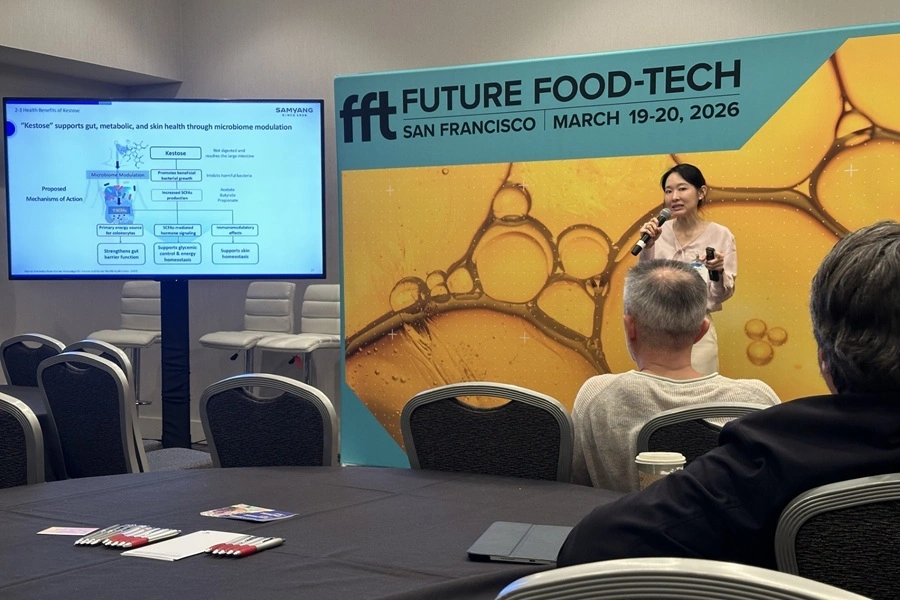 Samyang showcased its sugar reduction and fiber portfolio, including crystalline kestose, at Future Food-Tech in San Francisco.The broader GLP-1 trend is reshaping F&B across categories, with fiber in particular seeing increased demand from GLP-1 users seeking gut health support alongside weight management.
Building the toolbox
Samyang’s portfolio approach pairs kestose with two established ingredients. Nexweet allulose is a clean label sugar alternative providing sugar-like taste and functionality with advantages in calorie and sugar labeling. Fiberest resistant dextrin improves body and texture while contributing fiber. Kestose shares similar nutritional benefits to the resistant dextrin but adds what the company calls premium differentiation through its crystalline form.
Balancing taste, texture, and process stability remains a key challenge, Lee acknowledges. The company is expanding beyond sweeteners into fiber and texturizing ingredients, including modified starches, and is leveraging a large internal database built through its solution center to develop customized solutions tailored to each customer’s product.
The portfolio strategy reflects a wider industry shift toward systems-based sugar reduction, with suppliers moving away from single-ingredient swaps toward blended approaches combining rare sugars, fibers, and taste modulators. Samyang previously highlighted its Nexweet, Fiberest, and kestose ranges at IFT First in 2023.
AI enters the formulation lab
Samyang’s 3S (Smart, Simple, Successful) Sugar Reduction Solution provides optimized blending guidance based on sugar reduction targets, cost, and application categories.
“This system not only shortens R&D timelines but also enables rapid delivery of category-specific, customer-tailored solutions aligned with market needs,” Lim says.
The company first unveiled the AI platform at IFT 2025 in Chicago last July, where it showcased cereal bar prototypes developed using the tool. It expanded the system’s applications to pectin gummies at Supply Side Global 2025 in Las Vegas in October, and brought it to Natural Products Expo West earlier this month.
Samyang is also developing predictive models that analyze sweetness profiles and synergy effects among high-intensity sweeteners to identify optimal blends.
End-to-end ambitions
Samyang says it aims to be an end-to-end solution partner, supporting customers from product concept to commercialization — from global CPG companies seeking reformulation to emerging brands launching differentiated products.
The company has nearly a century of experience in food ingredient manufacturing and operates US offices in New York and San Diego. It received FDA GRAS status for its allulose in 2020 and opened a dedicated specialty ingredient plant in Ulsan, South Korea, in 2024 with annual allulose production capacity of 13,000 metric tons.
“Sugar reduction and fiber fortification are no longer trends, but essential components for improving global health,” Lim says. “Through innovative ingredients, such as allulose and kestose, Samyang is committed to building a future food ecosystem that supports both enjoyment and healthier living.”