

Scientists upcycle sunflower oil waste for high-protein, nutrient-rich bread


Key takeaways
- Scientists in Brazil use partially defatted sunflower seed flour to develop high-protein, fiber-rich bread.
- The bread offers health benefits over traditional wheat bread by providing significantly more protein and antioxidants.
- The findings support a circular economy by reducing waste and provide a low-cost, eco-friendly alternative to wheat flour.
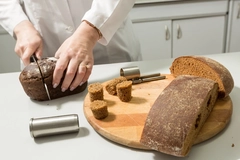
Scientists in Brazil have utilized sunflower oil waste to develop bread higher in protein, fiber, and antioxidants, as consumer demand for healthier alternatives to traditional wheat-based food pushes F&B research.
The findings can help manufacturers use partially defatted sunflower seed flour, a by-product of industrial sunflower oil extraction, to formulate functional bread while reducing waste and supporting the circular economy in sunflower oil production.
Sunflower seed flour or “nugget” has a high protein content — ranging from 40–66% (w/w) — making it an alternative and “promising protein source” compared to animal sources, the researchers note.
“Our aim was to optimize the reuse of sunflower seed flour considering its high protein and chlorogenic acid content,” says lead author and biologist Leonardo Mendes de Souza Mesquita, at the Institute of Biosciences of the University of São Paulo (IB-USP) in Brazil.

Using sunflower seed flour increases the nutritional value of bread while also reducing the environmental footprint of sunflower oil production. The by-product is also a low-cost ingredient, since it is sold cheaply to avoid disposal, Mesquita adds.
Replacing wheat flour
The team replaced wheat flour with sunflower seed flour at levels ranging from 10–60% to evaluate its performance in baking.
The findings, published in ACS Food Science & Technology, revealed that breads formulated with sunflower seed flour contained significantly more protein and fiber than standard wheat bread.
Bread with the highest substitution of sunflower seed flour reached 27.16% protein, compared with 8.27% in conventional bread. Antioxidant levels also increased alongside protein content.
“The result reinforces the potential of sunflower seed flour to promote health benefits associated with reducing oxidative stress,” says Mesquita. He also notes strong inhibition of digestive enzymes, including α-amylase (92.81%) and pancreatic lipase (25.6%).
This opens up opportunities to develop bread containing sunflower seed flour or its aqueous extract (made by mixing sunflower seed flour with water and filtering the mixture), which can slow the digestion of starches and fats for health benefits.
Meanwhile, higher amounts of sunflower seed flour impacted bread’s appearance and texture. When sunflower seed flour made up 20% or more of the recipe, loaves became “smaller and firmer,” note the scientists. Changes in crumb structure increased the density and reduced softness.
“However, adding the aqueous extract managed to preserve the structure and texture of the breads, keeping them close to those of traditional wheat bread,” says Mesquita. He explains that this approach can enable bakers to gain the nutritional benefits of sunflower flour while minimizing its negative effects on texture.
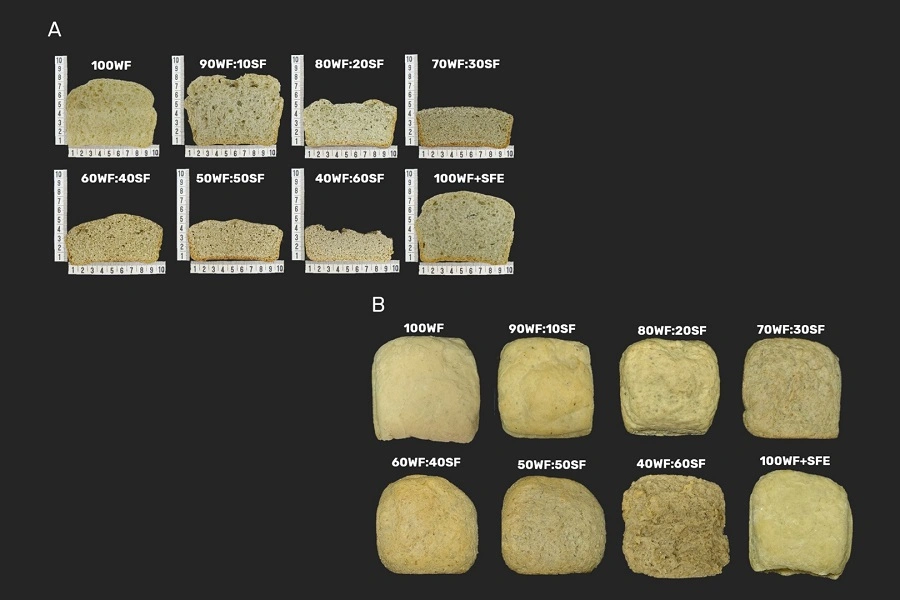 Bread formulated with different proportions of wheat flour (WF), sunflower seed flour (SF) and its extract (SFE) (Image credit: Leonardo Mendes de Souza Mesquita).
Supporting the circular economy
The research aims to explore productive uses for industrial leftovers, which when re-used, can reduce costs by 4% and environmental impact by 11–19%.
“Transforming waste into products is a fundamental strategy for promoting a circular economy and reducing resource waste,” says Mesquita. Partially defatted sunflower seed flour supports human health while also delivering environmental and economic benefits — addressing all three pillars of the circular economy.
He adds that manufacturers want to move away from the traditional “extract, produce, discard” approach, keeping materials in circulation longer to maximize their value and regenerating resources at the end of each cycle.
In this study, the team turned an overlooked by-product into a functional ingredient that enhances bread nutrition while reducing waste.
What’s next?
Mesquita suggests that future research could explore whether sunflower seed flour’s aqueous extract could fully replace sunflower seed flour or be blended with it in different ratios.
Commercial bakeries could then determine which formulations work best at scale.
The research involved researchers from Brazil’s Multidisciplinary Laboratory of Food and Health at the School of Applied Sciences of the State University of Campinas in Limeira, and the Laboratory of Food Technology and Nutrition at the Federal University of São Paulo on its Baixada Santista campus.
It received funding from the São Paulo Research Foundation through six projects.


Upcoming webinars
Oat-Standing Ingredients - Showcasing Irish Grain Through Innovation
Tirlán Ingredients

2027 Food Safety Risks for Quality & Compliance Leaders
FoodChain ID

Formulating for function: Developing benefit-led beverages with natural colours, botanicals, and flavours
Givaudan Sense Colour