Seprify secures IKEA backing to scale cellulose-based TiO₂ alternative


Key takeaways
- IKEA invests in Seprify’s titanium dioxide replacer amid rising circular economy and sustainability focus.
- Seprify’s clean label platform offers manufacturers comparable whitening in applications like bakery icings and confectionery with a lower environmental impact.
- Regulatory scrutiny and consumer demand are accelerating the shift toward scalable bio-based alternatives to titanium dioxide.

Swiss biomaterials company Seprify has raised €13.4 million (US$15.4 million) to scale its cellulose-based alternative to titanium dioxide (TiO₂) for use as a whitening ingredient across foods, cosmetics, and coatings. Inter IKEA Group has supported the funding, citing the “technical maturity” of Seprify’s solutions and its role in advancing more sustainable, circular material solutions.
SilvaAlba — Seprify’s plant-based, food-grade additive — allows food manufacturers to replace TiO₂ with a clean label, scalable, and lower-carbon whitening ingredient without impacting functionality or product appearance.
TiO₂ is regulated by the US FDA as a color additive in bakery products and candy, at levels not exceeding 1% of the food by weight. However, Innova Market Insights research indicates that many US consumers want the additive phased out amid rising demand for clean, transparent ingredient lists.
In the EU, the potential health risk colorant has been banned in foods since 2022, prompting a surge in substitute innovations in the F&B industry.
Seprify says its cellulose-based alternative offers “strong whitening performance” without the regulatory and sustainability challenges associated with TiO₂. It also responds to growing demand for scalable, bio-based alternatives to high-emission incumbent materials, such as TiO₂.
“The technology delivers comparable opacity, brightness, and whitening effect, while offering practical formulation benefits, such as fast dispersion, stability across heat and pH ranges, and neutral flavor and odor,” Lukas Schertel, co-founder and CEO of Seprify, tells Food Ingredients First.
“From a scalability perspective, our focus is on providing a solution that manufacturers can adopt at an industrial scale. That means consistent quality, reliable supply, and ingredients that integrate into existing manufacturing processes without major changes.”
Inter IKEA Group invested in Seprify to support its “promising cellulose‑based technology more closely” and understand its potential at an industrial scale, Robert Carleke, innovation ventures manager at the group, tells us.
The company’s move toward circular solutions includes exploring low‑carbon, bio‑based options with innovators like Seprify.
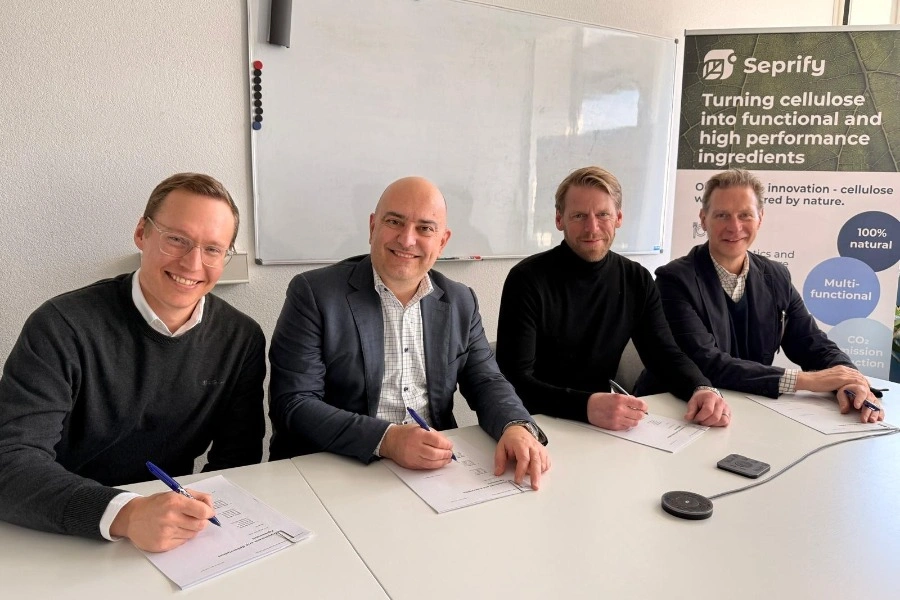 Left to right- Seprify CEO and co-founder Lukas Schertel, Luca Zerbini, board director of Una Terra (investor), Robert Carleke, board director of Inter IKEA Group (investor), and Oliver Polcher, co-founder & chairman of the Board at Seprify.
Meeting F&B functionality demands
Schertel describes Seprify’s cellulose platform as a “whitening and opacity solution” in F&B that can replace TiO₂ while maintaining visual performance.
“Initial applications include bakery icings, confectionery coatings, sauces, jelly gum, hard-boiled candy, plant-based dairy products, coffee creamers, and powdered beverages,” he says.
Manufacturers can integrate the ingredient into existing manufacturing processes since it is functionally “sensory neutral, easy to mix, and stable across heat and pH ranges.”
The primary benefit for them is formulation practicality. “Seprify’s cellulose platform delivers strong optical performance while remaining easy to disperse, sensory neutral, and stable across different food matrices.”
A credible alternative to TiO₂
From a label perspective, SilvaAlba enables brands to move away from TiO₂ toward a “plant-based microcrystalline cellulose solution” that supports clean label positioning, Schertel notes.
“From a sustainability perspective, the ingredient is plant-based, biodegradable, and derived from renewable cellulose sourced from FSC-certified wood pulp, with an estimated 80% lower CO₂ emissions compared with TiO₂.”
A 2024 life-cycle assessment of tTiO₂ production found that it generates nearly 3.69 kg CO₂-equivalent per kg of the additive through the sulfate production process.
“We are seeing two trends happening at the same time — regulatory pressure, such as the EU ban on TiO₂ in food, and growing consumer demand for ingredients that feel more natural and easier to understand,” says Schertel.
Seprify’s approach uses renewable cellulose, a plant-based ingredient already familiar in food systems, allowing manufacturers to “replace controversial ingredients, while maintaining the functionality they need.”
“The goal is not simply to remove an additive, but to provide a credible alternative that works technically, fits regulatory frameworks, and aligns with consumer expectations.”
 Seprify’s cellulose-based ingredients offers consistent whitening in coffee creamers, bakery icings, confectionery coatings, and plant-based dairy products.
Overcoming scaling hurdles
Schertel explains that scaling a new ingredient in the food industry requires more than production capacity, since manufacturers need “consistent quality, reliable supply, and strong application data” before reformulating at scale.
“With the Series A funding, our priority is delivering reliable supply while supporting customers as they move from testing into procurement discussions and early commercial supply.”
“Another challenge is the diversity of food systems. Ingredients behave differently across categories, which is why we work closely with partners to generate application data across multiple food matrices.”
Tapping cellulose’s versatility
As food manufacturing undergoes a “structural shift,” Schertel points to mounting pressure on companies to maintain performance and cost competitiveness, while reducing reliance on materials with regulatory or environmental challenges.
“Cellulose has a major role to play in that transition. It is abundant, renewable, and versatile, and when engineered correctly, it can deliver functional properties such as whitening, texture, and optical performance.”
For Seprify, the goal is to build a cellulose technology platform that supports multiple industries, including food, pet food, personal care and cosmetics, nutraceuticals, and coatings. The company is currently working with over 100 customer organizations on active evaluations and early commercial supply.
Inter IKEA Group participated in the funding alongside other investors, such as Una Terra Early Growth Fund, Zürcher Kantonalbank (ZKB), Cambridge Enterprise Ventures, and Kickfund.
Carleke tells us that Seprify's backing is part of a “selective, purpose‑driven approach to test and learn alongside partners in areas that may become important for the future.”
“Seprify stood out because it has a strong scientific foundation with technical maturity and a platform that has already shown encouraging early results in our work so far.”