


Beefing up clean meat: 3D technology helps Aleph Farms scale up production

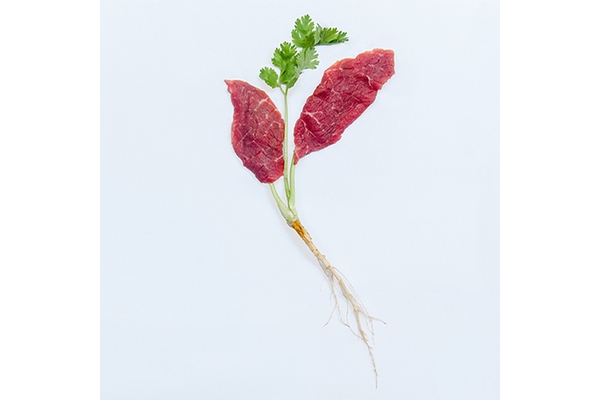
02 May 2018 --- Israeli food-tech start-up, Aleph Farms Ltd., is one of only a handful of clean meat companies globally, and until now, clean meat has been limited to structures of one or two types of cell tissue, limiting its applications to ground meat. The company has just announced two significant advances in the production of clean meat: expanding the composition of the meat itself and growing it in a more structured way.
Aleph Farms’ 3D technology relies on creating a complex tissue composed of the four core meat cell types. They are then able to grow these cells on an intricate proprietary three-dimensional platform. Aleph’s clean meat mimics traditional cuts of beef in both structure and texture, but without beef’s substantial environmental impact, its burdensome resource requirements, or its contribution to climate change.

The world-class scientific team behind these innovations is headed by Professor Levenberg, Dean of the Bio-Medical Engineering Faculty at the Technion – Israel Institute of Technology, a top science and technology research institution. Scientific American named Levenberg one of the world’s 50 leading scientists for her groundbreaking interdisciplinary work in tissue engineering and regenerative medicine. Now, she’s using her expertise to advance clean meat.
 “It has been a major hurdle to mimic meat’s many properties, such as texture, shape, juiciness, and flavor,” states Prof. Shulamit Levenberg, Co-Founder and Chief Scientific Officer of Aleph Farms. “Our use of the four cell types found in conventional cuts of meat, including vascular and connective tissues, is the key to a product that will be closer to the beef that people crave.”
Speaking exclusively to FoodIngredientsFirst, Didier Toubia, Co-Founder and CEO of Aleph Farms said: “The two key challenges for clean meat are, firstly, the cost of production and the scale up. Producing a large amount of meat at a low-cost with processes that fit in line with the vision of clean meat has been quite well addressed by the industry, but has been a challenge. Secondly, the ability to provide an attractive end product, not necessarily a protein, but a new approach using advanced technology which can be used in an end product, which provided a new eating experience.”
“Consumers – especially millennials and flexitarians – care about animal welfare and the environment,” explains Toubia. “At the same time, they want to eat juicy, indulgent steak – not just ‘protein.’ Our goal is to help these consumers adhere to their personal standards while getting to enjoy safe, sustainable meat.”
“There is definitely a demand for clean meat in the industry today and this is mainly driven by consumers from both the US and Europe,” he notes. “Meat-eaters are looking for better solutions so that they can continue to eat meat, which has been produced in a more sustainable way, for the future of the planet.”
“As an Israeli company, we will be shipping worldwide, we are required early in the development process to look for markets outside of Israel and where we see a demand from their consumers.”

Toubia maintains that food safety is a major concern in both the US and Europe. “The advantages of clean meat mean that you can produce meat in a controlled environment. It is real beef from the same cow, but by developing it in this way, we can make sure that the end product is free from any contamination. In my opinion, that is one of the main advantages of clean meat,” he claims.
With the development of food ingredients or products, it has to go through regulatory and food safety checks, says Toubia. “Instead of a lab environment, we use a similar process to that or beer processing, so the meat in ‘grown’ in similar ways to breweries, in large tanks, called bio farms.”
Toubia believes that “an attractive end product clean meat is the key to success and worldwide interest is growing. Food is consumed for the experience and we want to focus on the unique eating experience for our consumers,” he notes.
Currently, issues around beef production have been raised as a concern, regarding sustainability, the efficiency of production and animal welfare. According to Toubia, this unique technology will gain traction in the industry and Aleph Farms hopes to offer more solutions for clean meat to the industry as a whole.
Bruce Friedrich, Executive Director of The Good Food Institute (GFI), a non-profit promoting the clean meat industry, is excited about Aleph Farms’ vision for the future. “GFI’s objective is to help leading scientists and entrepreneurs apply their expertise to clean meat development. Israel’s start-up mindset allows the team at Aleph to leverage this rich history and technological leadership to create breakthroughs in clean meat,” he says.
This comes at a time when there is increasing consumer demand for protein that impacts less on the environment and is less reliant on feed, land and water.And it isn't the first time innovators have been active in this area.
Back in August last year, clean meat innovators Memphis Meat received groundbreaking support from investors, including billionaire entrepreneurs Sir Richard Branson and Bill Gates, as well as one of the world’s largest global agricultural companies, Cargill. Based in the San Francisco Bay Area, Memphis Meats is developing methods to produce meat directly from animal cells, without the need to breed or slaughter animals.
It released the world’s first clean meatball last February and the first-ever clean poultry in March 2017. It plans to bring real meat to the market that is marketed as significantly better for the environment, animals and public health.
The rise of cultured meat has been a key discussion area for several years, with pioneering research from the University of Maastricht leading to the creation of the spin-off company MosaMeat in 2015, two years after a US$250,000 artificial meat hamburger was presented to the world’s media to much hype, the technology has entered a new stage, with commercial viability moving significantly closer. You can read more about our initial reporting on this here.
By Elizabeth Green
All content and features on this website are copyrighted with all rights reserved. The full details can be found in our privacy statement