


Scientists unlock genetic resistance to combat Fusarium wilt disease in bananas

Key takeaways
- Researchers in Australia have discovered a natural resistance to Fusarium wilt in the wild Calcutta 4 banana.
- The research could lead to the development of stronger, disease-resistant banana varieties that help secure the future of the banana industry.
- The findings aim to support more efficient breeding of bananas to offer sustainable solutions for farmers facing banana crop health challenges.
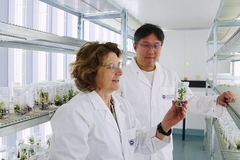 Study authors professor Elizabeth Aitken and Dr. Andrew Chen with tissue culture banana plants at the University of Queensland.
Scientists in Australia have identified a genetic trait in the wild banana subspecies Calcutta 4 that can help tackle Fusarium wilt, or “Panama disease,” which threatens the global supply of farmed Cavendish bananas. The findings could lead to the development of stronger and disease-resistant commercial banana varieties for farmers by supporting plant breeding programs.
Cavendish bananas were bred in response to Gros Michel bananas going extinct during the Fusarium outbreak in the 1950s, and fulfil most of the world’s commercial demands for the fruit today.
Studies estimate that by 2040, around 17% of global banana‑growing area — equivalent to approximately 36 million tons in production and worth over US$10 billion — could be affected if the Panama disease continues to spread without effective new resistant varieties.

Researchers at the University of Queensland, Brisbane, identified the genomic region that controls resistance to Fusarium wilt Sub Tropical Race 4 (STR4) of Fusarium oxysporum f. sp. Cubense species. STR4 affects bananas in subtropical regions around the world and is a genetic variant of Tropical Race 4, which is found in Australia.
“Identifying and deploying natural resistance from wild bananas is a long-term and sustainable solution to this pathogen that wilts and kills the host plant, leaving residue in the soil to infect future crops,” says author Dr. Andrew Chen.
“We’ve located the source of STR4 resistance in Calcutta 4, which is a highly fertile wild diploid banana, by crossing it with susceptible bananas from a different subspecies of the diploid banana group.”
Genetics for banana resilience
The research, published in Horticulture Research, mapped STR4 resistance to chromosome 5 in the Calcutta 4 banana variety, and is the “first” genetic analysis of Race 4 resistance from this wild subspecies.
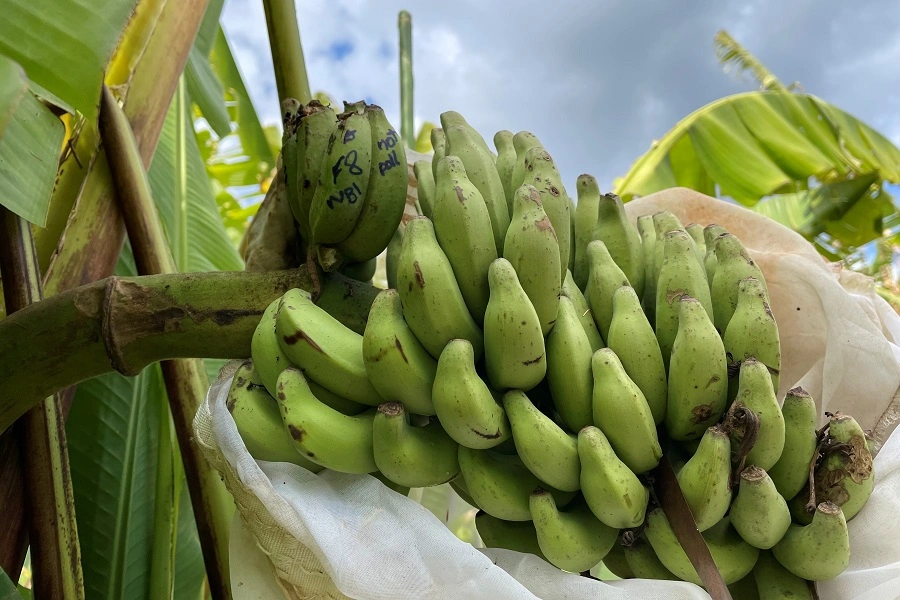 The findings can support future banana breeding programs to develop disease-resistant commercial banana varieties that are healthier and easier to farm.During the study, each generation of banana crosses was grown for at least 12 months before it was challenged, examined, and then used for further breeding once it flowered. After testing the new plants with STR4, the team compared the DNA of those that survived and those that did not.
The scientists used forward genetics (population development and disease screening), genome sequencing, and bulked segregant analysis for the research.
Targeting improved costs and farming
Dr. Chen expects the findings to help develop Fusarium wilt-resistant commercial banana varieties, but explains that the variety isn’t suitable as a commercial cultivar because “it doesn’t produce fruits that are good to eat.”
“The next step is to develop molecular markers to track the resistance trait efficiently so plant breeders can screen seedlings early and accurately before any disease symptoms appear,” he says.
“This will speed up selection, reduce costs, and hopefully ultimately lead to a banana that is good to eat, easy to farm, and naturally protected from Fusarium wilt through its genetics.”
Australian not-for-profit organization Hort Innovation has supported this research through the banana industry levy funds and contributions from the Australian Government. It will directly inform future Hort Innovation investments, which aim to convert genetic discoveries into practical tools for banana breeding and industry adoption.




Upcoming webinars

2027 Food Safety Risks for Quality & Compliance Leaders
FoodChain ID

Formulating for function: Developing benefit-led beverages with natural colours, botanicals, and flavours
Givaudan Sense Colour

Let's reveal the grain potential: Innovate
Meurens Natural