




Balchem: How meat sticks are evolving into premium, protein-rich snacks

Key takeaways
- Meat sticks are shifting from gas-station snacks to premium, protein-led, on-the-go products with broader demographic appeal.
- Processing innovations like encapsulated acidulation enable faster throughput, no-added sugar claims, and greater formulation control.
- Expanding retail channels and rising protein demand are driving strong category growth and scalability challenges for manufacturers.

The meat stick category is experiencing strong growth, with sales value climbing 29.7% year-on-year as consumers embrace convenient, protein-rich snacking. But for manufacturers, this surge in demand is not just about volume, according to US-based specialty ingredients company Balchem.
Ryan Goeser, meat business development manager, talks to Food Ingredients First about how distribution channels for the protein snacks are multiplying fast, with convenience stores, fitness centers, online retailers, vending operations, premium grocers, and direct-to-consumer models all demanding supply. This expansion presents challenges around scaling production to meet surging demand while maintaining the flexibility to serve diverse channels with vastly different requirements.
Goeser explores what’s driving the robust growth and expanding retail landscape of the meat stick category and examines innovative processing technologies, specifically encapsulated acidulation systems, that enable direct acidification — allowing manufacturers to eliminate long fermentation steps and dramatically increase throughput.

What exactly is the meat stick category, and how do these products differ from other protein snacks?
Goeser: Meat sticks are exactly what they sound like: ready-to-eat, snack-sized, and shelf-stable meat products with significant flavor, format, and positioning potential. Unlike some other protein-packed snack formats (powders or shakes), meat sticks represent a more “intuitive” approach. After all, when “meat” features in the product description, most consumers naturally, and correctly, assume it delivers a powerful protein boost.
In the past, meat sticks were characterized as simple “gas station snacks,” aimed at a predominantly male target audience. In the wake of the protein snacking revolution, the segment now attracts a much wider consumer base, and meat sticks are increasingly positioned as a premium, lifestyle-led snack. Some meat sticks may contain as much as 12 grams of high-quality protein in a convenient, easy-to-transport format, which slots perfectly into the drive for protein-packed snacks enjoyed on-the-go by consumers of any age or gender. And it’s not just the attractive nutritional benefits raising the profile of meat sticks. The adoption of specific production techniques has helped reposition the category from “men’s snacks” to products that appeal to women and children. In turn, we’re seeing brands experiment with more balanced, complex, or exotic flavor profiles with broader demographic appeal.
Why are meat sticks gaining popularity among today’s consumers?
Goeser: Meat sticks are enjoying such a stark rise right now thanks to a mix of market maturity and changing consumer expectations. As the category sheds its old associations with “road trip” gas station foods, brands are increasingly leaning into premium positionings that paint meat sticks as healthy, convenient, and high-value. A big part of this momentum comes from shifting demographics. Brands such as Chomps and Jack Link’s new LK (Lorissa’s Kitchen) line have helped reframe meat sticks for women and children rather than just male consumers. Meat sticks are (typically) individually wrapped, ambient-stable, and easy to eat on-the-go, making them the perfect convenient, protein-packed snack for busy parents to slot into their kids’ lunchboxes — or enjoy themselves on-the-go or after a workout. Their rise also dovetails with wider trends like active aging and, especially, the rise of GLP-1 agonists, which typically prompt users to seek out nutritionally dense products in smaller packages. In this arena, the protein-packed, no-added sugar claims enabled by Balchem’s MeatShure encapsulated acids become especially valuable, shifting meat sticks from niche fuel into on-trend, convenient snacks accessible to all.
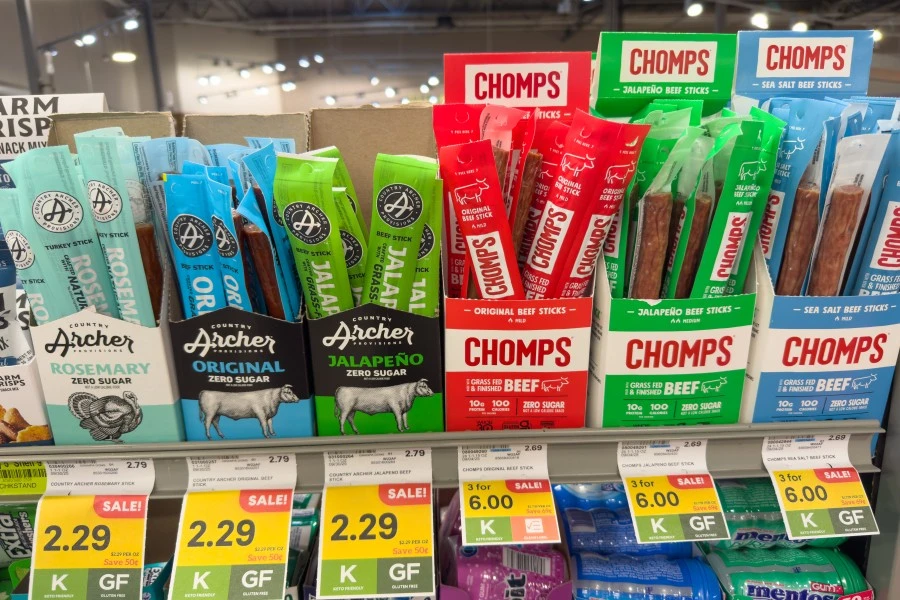 Meat sticks are typically individually-wrapped, ambient-stable, and easy to eat on-the-go, positioning them as a convenient, protein-packed snack.
Which types of meats and flavor profiles are most common in this category?
Goeser: The original — and for many, the best — base for meat sticks is beef, which still held the majority market share for meat snacks in 2024. Beef has held its prime position for so long thanks to its rich flavor and protein content, but now the proliferation of grass-fed and organic options has added another layer of premium appeal. While beef undoubtedly reigns in the market, producers shouldn’t discount poultry, either. In Europe, 60% of consumers eat poultry at least once a week, making it the most popular meat category in the region. Whether beef or chicken, consumers expect meat snacks to deliver tasty, savory flavor first and foremost. Traditionally, fermentation has been used in meat snack production mainly to preserve shelf life — the tangy, acidic notes it produces are by-products that are usually masked with bold or spicy seasonings. But intense, spicy flavors aren’t for everyone, so many formulators are exploring ways to create more universally appealing, flavorful snacks. Building on the shift toward more advanced production techniques, producers are increasingly moving away from traditional fermentation methods.
Instead, solutions such as encapsulated acidulants, like Balchem’s MeatShure, allow producers precise control over formulation pH and flavor development, while reducing processing time and eliminating the need for added sugars for flavor masking.
What challenges do new manufacturers face when entering the meat stick segment?
Goeser: New entrants to the meat stick category face several operational and capacity concerns before they can fully launch into this booming market. The most immediate challenge is the supply-demand imbalance. Some major category players have reported that, despite producing around 2 million units per day, they are still only able to fulfill about 85% of incoming orders. Clearly, in this structurally tight market, rapid scalability is a must, but boosting production capacity isn’t as simple as slotting in a new line. Building and equipping new processing facilities can take years of costly capital expenditure — something often out of reach for smaller or newer manufacturers.
Throughput constraints within existing plants can add another layer of pressure even for established producers. Smokehouses can have major bottlenecks in which throughput can be halted for 12 hours or more as fermentation takes its course.
How important is packaging in differentiating meat stick brands on crowded retail shelves?
Goeser: Packaging plays a pivotal role in helping meat stick brands stand out, especially as the category becomes more crowded and many fast-growing players rely heavily on co-packers. When product formulations are broadly similar, and manufacturing is outsourced, packaging becomes the primary tool for communicating quality cues, brand personality, and, especially, ingredient claims. With consumers on the hunt for “better-for-you” options, highlighting benefits such as protein-packed and zero-added sugar, as unlocked by encapsulates, can be a major differentiator. This is especially true considering the growing uptake of GLP‑1s, where users are increasingly seeking small, convenient, and protein-rich snacks that support their weight management. In short, distinctive, informative, and visually confident packaging is essential for attracting shoppers, new or existing, in a competitive category landscape.
Where do you see the meat stick category heading over the next 3–5 years, and how should producers prepare?
Goeser: The key word in our opinion is adaptability. The capacity issues faced by even leading brands demonstrate just how crucial process efficiency and scale-up are to capturing the full potential of the market, but production agility means more than just increasing throughput. Consumer demographics will change, meaning tastes will also change. In this context, technologies that allow precise control over acidity give meat stick manufacturers a versatile base from which unique, captivating flavors can be developed without the need for masking. Future market share will belong to the brands that stay fluid and go with the flow of wherever tides take the category next, investing in these technologies to respond dynamically to changing consumer tastes.