



How Afyren’s bio-based organic acids can support food reformulation


Key takeaways
- Afyren positions fermentation-produced, bio-based organic acids as direct replacements for fossil-derived acids in food preservation and flavor creation.
- The company says its acids match conventional alternatives on purity, functionality, and sensory performance, while delivering around one-fifth of the carbon footprint.
- Adoption is growing in preservation, natural flavors, and plant-based foods, but mainstream uptake will depend on larger-scale production, competitive pricing, and verified environmental data.

Biotechnology company Afyren aims to support manufacturers in replacing fossil-derived organic acids with bio-based alternatives for food and flavor applications. The move responds to growing consumer demands for F&B products offering sustainable, traceable ingredients, while helping companies reduce supply chain emissions without impacting product performance.
The France-based firm says its fermentation-produced ingredients can match conventional acids on purity, functionality, and processing performance, while delivering a carbon footprint “approximately one-fifth that of petrochemical equivalents.”
Organic acids are used by manufacturers for food preservation, controlling pH, extending shelf life, and creating sour, tangy, or fermented flavor profiles.
Afyren, founded in 2012, says it follows a fully circular and regenerative approach for the industrial production of “100% bio-based, low-carbon carboxylic acids.” The process uses local, non-food agricultural by-products, such as sugar beet residues, as raw materials.
Afyren’s approach aligns with the rise in consumer scrutiny of ingredient sourcing. Nearly three in four consumers globally reconsider purchases based on ingredient lists, suggests Innova Market Insights data. Honesty and transparency matter, as 58% emphasize the importance of clear information on ingredients and sourcing.
FoodIngredientsFirst catches up with Joachim Merziger, chief commercial officer at Afyren, to discuss bio-based organic acids’ applications in food preservation and natural flavors and how manufacturers can achieve mainstream adoption.
What is driving food manufacturers to reconsider conventionally produced organic acids, and where are you seeing the strongest demand for bio-based alternatives?
Merziger: Manufacturers are no longer evaluating ingredients solely on cost and functionality; they are increasingly expected to demonstrate transparency, resilience, measurable sustainability, and traceability throughout their supply chains.
Consumers are asking fundamental questions about where ingredients come from and how they are produced. The shorter the ingredient list, the better. They also increasingly associate fermentation, natural production processes, and regional sourcing with higher quality and greater trust. This is particularly evident in Europe, and the trend is now becoming global. Headshot: Joachim Merziger, chief commercial officer at Afyren.
What makes organic acids especially interesting is that they are functional ingredients present in countless food formulations. By replacing conventionally produced acids with bio-based alternatives, manufacturers can significantly improve the sustainability profile of their products without changing the functionality or sensory characteristics.
Which food, beverage, and flavor applications are gaining commercial traction first, and what is driving adoption?
Merziger: We currently see the strongest commercial momentum in three areas. First, food preservation, where bio-based propionic and acetic acids enable manufacturers to maintain shelf life while moving toward more sustainable ingredient sourcing.
Second, natural flavor creation. Many of our organic acids naturally occur in foods and play an essential role in flavor development. Through our Flavyren range, flavor houses can formulate natural flavoring substances that respond to growing demand for clean label and naturally derived ingredients.
Third, plant-based and alternative foods, where flavor complexity is essential. Organic acids are key building blocks for recreating dairy, cheese, and fermented flavor profiles, while supporting manufacturers’ sustainability ambitions.
Can Afyren’s bio-based organic acids compete on price with conventional fossil-derived alternatives without regulatory incentives or sustainability premiums?
Merziger: In the market segments where we operate, no direct regulatory incentives are applicable, and sustainability premiums cannot be taken for granted. Our objective has always been to combine environmental performance with industrial and economic competitiveness.
Using local agricultural co-products as feedstock gives Afyren greater control over a key cost driver. Our circular process valorizes everything entering the production system, with the only remaining co-product being a potassium-rich fertilizer sold to farmers. As industrial production continues to scale, we expect competitiveness to improve through economies of scale and process optimization.
Purchasing decisions are no longer based exclusively on the lowest price per kilogram. Food companies increasingly consider supply chain resilience, carbon footprint reduction, regulatory preparedness, and brand differentiation. Our objective is not to ask customers to pay more for sustainability, but to demonstrate that sustainable chemistry creates value for our customers.
How do Afyren’s fermentation-derived acids compare with conventional equivalents on sensory impact, shelf life, and processing stability?
Merziger: One of the strengths of Afyren’s technology is that we produce molecules chemically identical to their conventional counterparts; only the carbon origin differs, namely, bio-based rather than fossil-derived.
Customers can therefore expect the same functional performance in applications where these organic acids are already established. Whether the objective is preservation, pH adjustment, or flavor creation, the chemistry remains unchanged. Consequently, food manufacturers do not need to redesign formulations. For flavor applications, fermentation also provides an advantage from a consumer-perception standpoint.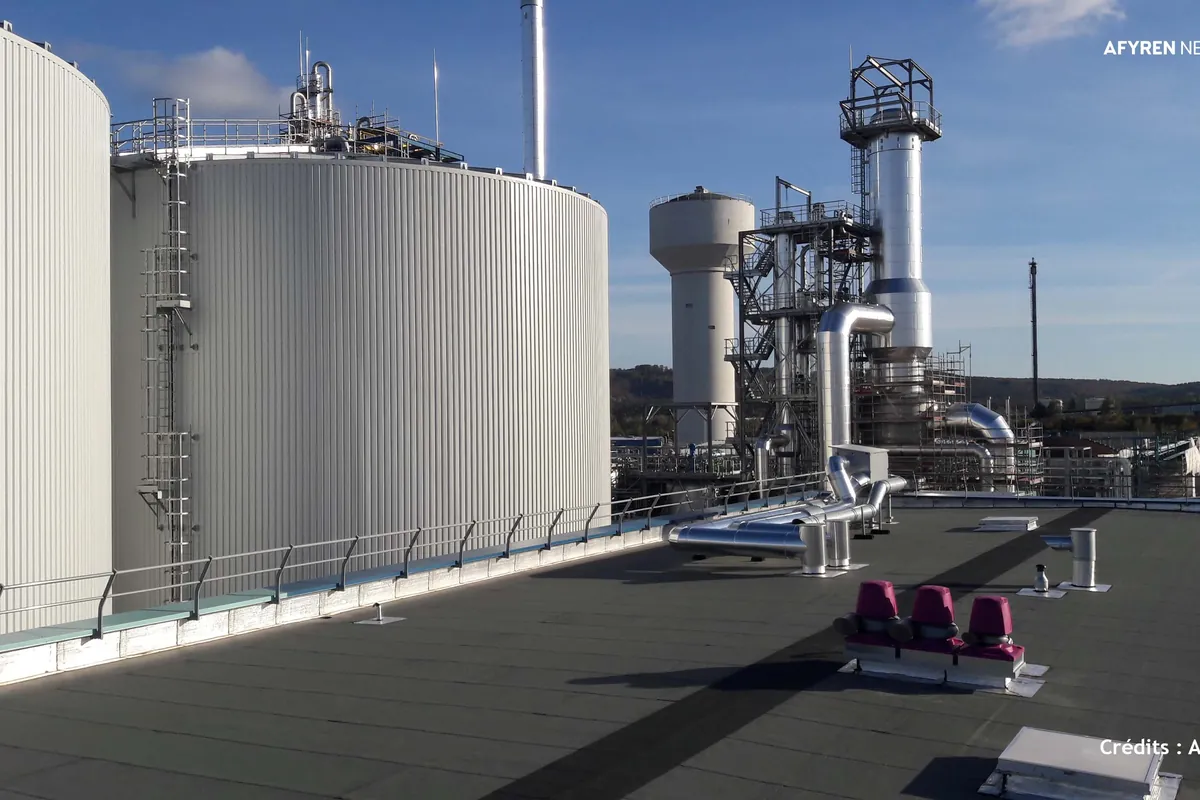 Afyren uses fermentation to convert agricultural co-products into low-carbon organic acids for food and flavor formulations.
This aligns with growing demand for naturally derived ingredients and clean label formulations. We manufacture our ingredients under stringent industrial quality standards, including FSSC 22000 certification, ensuring consistent quality and batch-to-batch reproducibility. Our ingredients are also suitable for vegan, halal, and kosher applications.
Ultimately, customers should not experience a trade-off between sustainability, technical performance, and price.
Afyren positions its acids as direct alternatives to petroleum-based molecules. What must your ingredients match or outperform to persuade manufacturers to change established formulations and suppliers?
Merziger: Our ingredients must perform exactly as customers expect. Food manufacturers have invested years in validating formulations, processing conditions, and suppliers, so any alternative must integrate seamlessly into existing production processes.
Our acids must match conventional products in purity (99%+), consistency, functionality, regulatory compliance, and processing performance, without requiring changes to manufacturing processes or assets. Our production process uses natural, non-GMO fermentation and agricultural co-products rather than petroleum feedstocks. This reduces GHG emissions while supporting circular resource use and regional supply chains.
Our technology also strengthens supply chain resilience by reducing exposure to fossil-based raw materials, carbon-intensive value chains, and evolving sustainability regulations.
What needs to change for bio-based organic acids to become mainstream food ingredients?
Merziger: The technology already exists. The real challenge today is accelerating adoption across the value chain. Food manufacturers need confidence that bio-based ingredients are not niche innovations but industrial solutions capable of delivering consistent quality, reliable supply, and competitive economics over the long term.
Scale is therefore essential. The industry needs sufficient production capacity to reliably serve multinational food companies with a global reach while maintaining the highest food safety standards. Companies increasingly want quantified reductions in carbon footprint, transparent sourcing, and full traceability. Importantly, companies need objective environmental data that can support their own ESG commitments.
The industry should increasingly value the origin of molecules, not only their chemical identity. Two molecules may be chemically identical, but their production pathways can have dramatically different environmental impacts. Our acids are produced from regional agricultural co-products through natural, biomimetic, non-GMO fermentation, rather than fossil resources. As production scales further and sustainability becomes an integral purchasing criterion alongside price and quality, bio-based organic acids will naturally become the new industry standard.