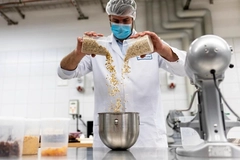



Sugar Reduction in Beverages
07 Nov 2016 | Covance
A warm welcome to all of today's webinar viewers who come from all around the globe.
Today's food ingredients first webinar is entitled Sugar Reduction in Beverages, Four Sweet Secrets for Success, and is sponsored by Covan.
This is a company which can offer advice on formulating and reformulating products for today's new markets.
So I think the the topic for our webinar today could not have been more timely.
A sugar reduction, particularly in the beverages space, is really in the spotlight.
The soft drinks industry has been working for many years towards low and low sugar reformulations with a whole host of new product launches in 2016 and more planned for the future.
And this is as companies and manufacturers continue on their quest to meet sugar reduction targets set for 2018 and beyond.
And when we look at O Market Insights product launch activity with either a low sugar, no added sugar, or sugar-free claim, soft drinks leads the way.
In fact, the percentage of product launches per category in the soft drinks space grew from 14.6% in 2011 to 18.1% in 2015.
And this is a rise of 3.5%.
This type of launch activity comes as part of an overarching shift in strategy in the food and beverage industry in recent years.
So while in the past the focus has been on fat reduction, there is a new look being taken at fat, and particularly at butter.
So while many products in the 80s and 90s simply replaced fat with sugar, which only helped to stimulate the obesity crisis, despite them being positioned on a low fat platform.
Now the world has completely woken up to the size of the sugar problem, especially since the media has been linking sugar to obesity.
For example, shocking statistics that were published this month to coincide with World Obesity Day claim that 268 million children will be overweight by 2025 if current trends continue.
Action is required to tackle sugar intake.
In fact, on May 20, 2016, the US FDA finalized the new nutrition facts label, and this includes that nutrition labels of packaged foods have to state the amount of added sugars as a percentage of the recommended daily calorie intake.
In March 2015, a World Health Organization guideline recommended that adults and children reduce their daily intake of free sugars to less than 10% of their total energy intake.
A further reduction to below 5%, or roughly 25 g, which accounts to about 6 teaspoons per day, would provide additional health benefits according to the WHO.
Now these type of announcements gained widespread coverage and have put the issue even more firmly on the agenda.
And the WHO recently came out and officially encouraging governments to impose legislative measures by taxing sugary drinks.
The WHO says that rolling out laws around the world would curtail sugar consumption and impact on diabetes rates.
Fiscal policies where at least a 20% increase is introduced to the retail price of sugary beverages would result in proportional reductions in consumption, according to the report which was published on October 11th.
The report talks about lowering the intake of free sugars, which are monosaccharides like glucose and fructose, and disaccharides such as sucrose or table sugar, as as sugars that are naturally present in honey, syrups, fruit juices, and fruit juice concentrates, which are added to food and drinks.
And reducing consumption of these free sugars will improve nutrition among populations with fewer people suffering from overweight, obesity, diabetes, and tooth decay.
Very recently, Portugal became the latest country to introduce a tax on sugary soft drinks, with government plans to bring in a levy next year, and this will increase the cost of a 330 mL soda bottle by around 5.5 cents and raise €80 million for public health.
Beverages with a concentration of up to 80 g of sugar per liter will be taxed by €8.22 per hectolitre.
There will be another level of €16.44 hectolitre and we'll focus on beverages in which sugar levels exceed 80 g per liter.
Milk-based drinks and juices will be exempt from the regulation.
And the Portuguese sugar tax will follow similar laws in France, Mexico, Hungary, and forthcoming legislation in the UK and South Africa, where there is heavy opposition to the plans.
So the next country to introduce the sugar tax is likely to be the UK in 2018.
However, it's important to note that Britain's food and drink industry has urged the government to lay its plans for the tax, fearing that it will add a burden on the industry.
And in the, in the original March 2016 budget, which was before the Brexit vote, the UK government announced that sugars in soft drinks will be taxed from April 2018.
And according to the plans, there will be two bands for the tax, one for drinks with more than 5% sugars, and a higher charge for those with more than 8%.
It's been calculated for a 330 mL can, the levy will be around 6 to 8 pence, but pure fruit juices and milk-based drinks are exempt from the regulation.
So all in all, sugar reduction and particularly the debate around the benefits of a sugar tax in tackling obesity is on the product development radar.
And therefore our webinar today is going to address 4 key considerations when it comes to product reformulation for sugar reduction.
And these are taste, flavor, texture, and calorie management.
And our speaker today is Nick Henson, who is senior technical Manager, Food Solutions at Covan.
And Nick is a food scientist by training and has 35 years of experience of working within the industry, particularly in product development roles.
And Nick has a strong understanding of how to get new products to market and has a passion for best practice in innovation.
And if you have any questions for Nick, please submit them during the presentation as we we'll be having a question and answer session shortly afterwards.
So Nick, the floor is yours.
Thank you, Robyn, and welcome everyone.
Today I'm going to To cover sugar reduction.
In beverages looking at the key challenges.
And routes to tackle the critical product considerations.
Just a brief word on our company.
Company is Covan.
We, support food and beverage companies across the life cycle of the product.
That covers, all aspects of product design.
On the left here, you see the classic elements of, the product development process, which we cover right through from idea generation through to commercialization and scale-up.
And then on the right side, we have comprehensive analytical capability around the globe, which allows us to support analytical requirements in the development phase and once the product gets to market.
We work across all categories in the food area and supplement area.
We have a particular expertise, in the beverage category.
I've listed some of the areas there that we typically cover, a broad spectrum of, products, as you can see, very relevant to today's discussion.
And as you delve into this, you realize how complex this is.
So we're talking ready to drink, concentrates, powders, agglomerates right through into tablet formats, all of those covered by our technologists.
So Robin has alluded to the emphasis that governments are placing on this area.
I've just shown here the, UK position.
And you'll see there that was announced in March this year and, implementation due for April 2018.
Of course, the first observation there is when you consider that many, ambient beverages will have shelf lives of between 6, 12, and 18 months, that's going to be quite a tight program for companies to reformulate and carry out all the required stability testing.
So, hence, you can see as an example, the pressure that food companies are, are under.
The other interesting point to note, somewhat of an anomaly, I think, is, you'll see that the levels of sugar that, where, where tax will apply.
Now, this tax does not apply to juice, pure juice products.
And when you consider that a pure juice will have a sugar content in the region of 8 to 10%, You can see somewhat of an anomaly where there will be juice products at that sugar level not taxed, and then you could potentially have soft drinks at comparable levels taxed.
So that shows some of the complexity of this situation.
OK, to the topic, sugar reduction in beverages, as I've already alluded to, very much a multifunctional challenge.
And today we'll flag as technologists, development groups, what you need to consider.
And how you might approach some of these key challenges.
I wanna go back a stage because this is, , an interesting, insight, I believe, into this wider debate.
And I wanted to flag why sugar or sweetness is so critical to food acceptability.
And what you'll see in this chart is the fact that humans develop a response to sweetness at a very early stage, so pre-birth.
And they have an innate positive reaction to sweetness.
Now the likelihood is that is because sweet products in nature will provide energy, so it's an inbuilt mechanism to seek out energy sources.
And in fact, of course, human breast milk is sweet, cow's milk is sweet.
The, the interesting factor here is if we are going to be providing consumers with sweet products that do not then provide energy, will they subconsciously seek out those energy sources from other elements in their diet.
So this is getting to the core of how successful this approach is going to be.
I think this is going to be an interesting factor as we go through this process in the years to come.
So, the first flag is, as you get briefed, on this topic, broad topic, sugar reduction, you need to be very clear on your specific objective.
I've identified a few critical areas here to be aware of.
Are you, for example, looking at total sugar?
Or are you, say, focusing on added sugar?
So an example here would be, you have a juice drink, it will have intrinsic sugar from the, fruit juices present and it will have added sugar, for example, from sucrose.
On the left side there, you might perhaps be looking at a position on, dairy intolerance.
So you might also be looking at the quite complex topic of lactose-free products.
In the middle there, you need to be clear, are you forced into a no artificial sweeteners position because of a label requirement?
Are you focusing perhaps just on refined sugar?
Are you focusing on naturally sourced sweeteners, so it's very, it's very important to ensure that your objective links back to any marketing campaigns or label claims that are going to be associated with the development phase.
So in terms of label claim, I've just flagged here, this is for Europe, the, legal requirements to meet, specific claims, useful reference.
You can see there the different categories.
Interestingly, sugar free doesn't mean completely sugar free.
You are allowed a very low level of sugar, often carryover.
And the interesting one there with no added sugar.
Not containing monoad disaccharide, straightforward, but the slightly grayer area of any food used for its sweetening properties.
Some of those are straightforward, so honey.
And other similar syrups, but you might be using, for example, fruit juices, fruit juice concentrates.
Now, if you're adding those for sweetening purposes, this category does not apply.
If you're adding them for flavor, then you'll be OK.
The other critical consideration is, are you looking at reformulating an existing product.
Or are you looking at developing a new product that meets specific sugar target levels?
Now, what you need to bear in mind is, and this is, this experience we've built up over many years, we believe that the first area there is actually more challenging than the second.
And that's because there is no magic bullet in this area.
It's not necessarily possible to provide an exact match of an existing product at a reduced sugar level.
So we would strongly advise if you're presented with this challenge around existing product reformulation, to focus on meeting consumer acceptability rather than providing an exact match.
And as long as you have that consumer acceptability, that should be an adequate position to take.
So if we look broadly at sugar reduction, how it impacts, across food products.
And most of these will apply to, to beverages, but the key factor here is taste is king.
This is non-negotiable as far as the consumer is concerned.
They are going to expect good tasting products.
And, and they would consider taste to be the broad sensory quality, the broad sensory delivery, for the product.
And for the purposes of this session, we're talking about basic taste.
We're talking about mouthfield, texture, body.
We're talking about sweetness and flavor.
So the 4 key challenges, Robin alluded to those.
I focused on those 4, sensory elements plus, calorie management, which is really one of the drivers behind government's, approach in this area.
So number one, taste, and by that we mean the basic taste of sweetness.
But the key factor I want to raise here is that sugar actually controls the balance across other basic tastes.
So if you have an inherent, bitterness in your product, if you have some acidity in the product, as you alter the sugar levels, not only will you adjust the sweetness, but you will adjust the perception of the bitterness and the acid.
And this is a very important consideration.
What this means is you may be needing to adjust other elements of the product such as bitterness, acidity in order to deliver a balanced product.
Salt is less of an issue.
Salt's less of an issue in beverages.
Some sports drinks, rehydration drinks have a salty character, perhaps less studied at this stage.
And the other key factor there I've just highlighted on the bottom right is where you're using a material to replace pure sugar, you need to consider that that in itself may be bringing other tastes into the system.
They may be bringing mild bitterness.
Let's say you're using fruit juice concentrates, you may be bringing acidity, into the system.
So you can see how, there's some complexity in controlling across all the tastes.
So sweetness impact.
And here we're talking about sucrose as the, as the benchmark, , the alternatives being bulk sweeteners.
And, we'll come on to this, but all except one, of the bulk sweeteners will have a lower sweetness level than sucrose.
The high intensity sweeteners, obviously delivering increased sweetness.
But then critically, the Matrix, The Matrix, the background characteristics are going to impact sweetness.
So the pH and the acidity.
The solid level, which we'll talk about.
The flavors, the flavor system.
This is a very interesting area.
Certain flavors, although not sweet per se, will provide an impression of sweetness.
So for example, certain vanillas.
Certain brown flavors such as caramels, and certain pure flavoring ingredients are able to deliver a sweetness impression.
And these are very useful in balancing sweetness delivery.
Carbonation I've put there, carbonated beverages, the CO2 in the carbonated beverage will try to dissolve in the aqueous phase and produce acidity.
So the level of carbonation will impact acidity, acidity will impact the perception of sweetness.
And then finally, their synergistic effects, not that understood, but when you have combinations of sweeteners, it is possible that you'll have an effect greater than a simple additive effect.
It is known that sucrose and fructose actually do exhibit this effect.
So standard reference table here, provides you some guide on, sweetness equivalents.
It's not comprehensive.
There's much more data available, but it's quite a useful reference.
Monosaccharides you'll see there, and, you'll see all of those, except fructose, interestingly, less sweet, than sucrose, sucrose at one.
And the fact that fructose provides potentially, a higher sweetness intensity is useful, because you can have, less fructose for an equivalent sucrose sweetness.
You'll see there once you get to the longer chain carbohydrates down the bottom there, oligosaccharides, maltodextrins, for example, significantly less sweet, not really giving any substantial sweetness.
Then on the right-hand side, you'll see I've listed again for completeness sugar alcohols, often known as polyols, very interesting materials broadly in sweetness control, but do have restrictions at the legal level for soft drinks, particularly in Europe.
So, they're actually very limited in terms of their legal ability to be used in soft drinks, but you can see the relative sweetness levels.
High intensity sweeteners, we see again, not necessarily comprehensive, but I listed some data here and you can see substantially sweeter than sucrose against sucrose at level one.
And the range here is because sweetness perception does change at different concentrations.
I think one I'd like to flag here would be stevia.
Stevia, for example, as you gradually increase the concentration of stevia in water, sweetness perception increases, but it increases to a maximum.
And above that, you get no further increase in sweetness.
And this is why stevia is good for partial replacement of sweetness, up to about 5%.
So crows, but beyond that, it's not having additional sweetness benefits, so very interesting, very useful information to know about stevia.
This to me is a, this to me is a key piece of information.
This is the temporal profile of sweeteners.
So when you put the sweetener, the material into your mouth, the impression you get of sweetness over a period of time.
And you'll see here the way scros behaves, the gold standard.
You get a gradual.
Rise in sweetness, peaks, and then drops away.
And you can see, interestingly, fructose there, much more rapid in, impression of sweetness early on, rises to a higher peak and then drops away more quickly.
And this is why if you simply use the sweetness equivalents on paper to develop a formulation, and you prepare that formulation, you will find quite likely the sensory perception will not be the same.
The two products will not be the same because this applies across all sweetener systems.
I've not included the, not included the high intensity sweeteners here, but they tend to have Quite a rapid onset of sweetness and some of them can have quite a lingering effect.
So long after the sweetener has left your mouth, you're actually still getting a perception of sweetness, and you do find different people are susceptible to this to different levels.
So this is really the complexity, when you're looking at replacing sucrose.
OK, number 2 is flavor.
And the critical thing here is that sweetness directly impacts flavor perception in beverages.
And you can demonstrate that by taking your reference product and gradually reducing the sugar level.
And you'll get to a point where not just does the sweetness reduce, but the perception of flavor, perception of flavor.
As scored by the panels will start to decrease as.
And hence you can determine what's called a no difference level for sugar reduction, and this is actually an extremely useful exercise to carry out.
Because one tactic here And as a cross reference, this was the tactic used by the bread industry, certainly in the UK to reduce salt.
And what they did was they reduced salt in the product in bread at subthreshold levels.
Such that the level of salt was going down, but people were not able to detect a difference in either saltiness or flavor.
That product was then launched into the market.
Over a period of time, that became the benchmark, and then the next step was taken.
And gradually then you're able to reduce the level of salt or perhaps sugar in this case without significantly impacting people's acceptability of the of the product.
Now you're not going to be making big leaps here.
You're going to be making small changes, but it's quite an interesting Approach.
If, however, you're looking for more dramatic reduction, the chances are you're going to have to rebalance the flavor.
Now on paper this could simply be increasing the concentration of added flavor.
This may do the trick, but generally, You may be looking at rebalancing the flavor, adding other flavors in to get the correct impact.
Again, from experience, I would just flag one very important here in your work.
Temperature is temperature of tasting is absolutely critical in the perception of both sweetness and flavor.
So you need to ensure a consistent flavor across the tasting of your samples.
So if we look at some of the alternatives, we need to bear in mind that in some cases they can introduce flavors of their own.
And of course this is one of the beauties of sucrose.
It provides sweetness.
It's a very bland material.
So you can see here some of the early, generation stevia products, they had their own characteristic flavor, which was sometimes described as licorice.
It is true to say that the The more recent generation of stevia products have much cleaner flavors.
Plus the fact the flavor industry has developed quite effective what they would call sweetness maskers or sweetness modulators which can be used to reduce The flavor impact of intense sweeteners.
Gain for completeness, I've flagged polyols they're not widely used in beverages, but where they are, they have quite an interesting sensation at higher levels, a cooling effect, and they can sometimes be perceived as having a metallic flavor.
And then of course when you get onto compound materials, fruit juices, fruit concentrates, they're going to bring their own characteristic flavors into the system.
Thirdly, texture.
Interesting one because often if you talk to consumers, they don't see, beverages having a texture, but they certainly do.
And this is described as viscosity, thickness, mouth feel, or body.
And this is very much linked to, the soluble solid level.
And of course, as you drop sucrose, for example, you're reducing the soluble solids and the challenge there is how am I going to replace that, that mouthfeel the bodying effect.
And I've just flagged a few options here, classic options in your, in your palette of materials.
Low to medium chain carbohydrates, sometimes called oligosaccharides, you see I've listed a few there.
Highly soluble, and although not particularly sweet, they will bring body back into the, into the drink.
Soluble fibers, again, low calorific value, very low sweetness, but these materials hydrate to a high degree, and will give, a bodying effect in the drink.
And then thirdly, a big group of hydrocolloids sometimes used gut called gums or stabilizers.
These are materials that at relatively low concentration have quite a significant impact on the body of the drink.
So you can drop sucrose back, add these materials in, and they will to a certain extent replace the bodying effect of the sucrose.
So finally, calorie management.
And this is, as I say, at the heart of, some of the governmental initiatives, to reduce, obesity and overweight.
And what I flagged here is it's important to be clear on your tactics.
So are you looking to make a calorie reduction?
Chances are you are, and are you then looking to make a specific claim around calorie reduction?
Now if you are, the chances are your approach is going to focus on the high-intensity sweeteners and it's going to focus on soluble fibers and gums.
So you're able to replace sweetness, but not provide the replacement of the calories.
The second area would be where you're looking to maintain the calories.
And you might ask why would you be wanting to do that.
An example would be, for example, energy drinks and sports products.
So you may be wanting to provide an energy specifically for the targeting of the drink, but is the sweetness.
So here you're going to be looking at materials that don't necessarily provide sweetness but still provide calories and energy.
And these would be the short to medium chain carbohydrates that I referred to earlier.
And just as an aside, in sort of in dairy and soy-based drinks, you may be able to use proteins, fats, and milk solids.
These can be very useful in maintaining calories without bringing significant sweetness.
And keep in mind that each gram of sugar that you remove is going to be removing 4 kilocalories of energy from your drink.
Calorie management, now just talking about the permitted claims.
This is the European position.
Again, links back to your brief.
Are you looking to make an energy claim?
Listed here are the criteria you need to consider.
Interestingly again here, energy free doesn't mean totally energy free.
4 kilocalories per 100 mL, that's basically 1 g of carbohydrate.
And just again for reference, standard data here.
So all mono and disaccharides are giving 4 kilocalories per gram.
Similarly, maltodextrins classified as carbohydrates, giving 4 kilocalories per gram.
Fibers are useful, as I mentioned, because they have a lower calorie density.
They essentially will be delivering 2 kilocalories per gram.
And then polyols, if you can use them again, a lower calorie density.
Just a flag here on the check.
If you're using complex syrups, do check their composition.
They may have variable composition.
They'll obviously have solids.
They'll have water.
They may have fibers or carriers.
Likewise, proprietary gums and thickeners that you purchase, may have, may have a mixture of components including, including carriers.
So do check the composition of the materials that you're using as replacers.
Just bringing up one side issue here, not part of the mainstream discussion at the moment, but I think it could become more of an issue again or more of a talking point again.
This is a glycemic index.
This is the way the body handles sugar or metabolizes sugar when it takes it in.
An area that came to the fore 1520 years ago.
And is likely to be relevant in diabetes and how the body metabolizes sugar.
This is essentially a reference method to understand the level of blood glucose response when a food product or a sweetener is consumed.
And here the reference material is glucose, which has a glycemic index of 100.
And essentially people are fed the product, blood samples are taken, and then a response curve for blood glucose is provided.
And you can see there, interestingly, some of the sweetening materials actually have a lower glycemic index than sucrose, and this may be considered to be beneficial.
So wrapping up, I've highlighted some of the materials that are available.
I've just listed here, in one slide, so you have that in one place.
These are typical sort of commercial materials that are available to you, a whole range of, intense sweeteners.
Including some of the sweet proteins like thin.
Some natural, compounded sources of sweetness there, the syrup, fruit juice concentrates, honeys, agaves, milk concentrates.
And then very useful those medium to long chain carbohydrates, quite bland, quite soluble, delivering calories but not delivering sweetness.
And then the polyoles and the fibers.
Intense sweetness just flagging here there are obviously a range of different ones, so this is a little bit of a generalization, pros and cons.
Cons would be, I talked about the sweetness profile.
It can be quite intense, can be quite lingering.
Flavor balancing is needed as you don't have the, soluble solids there.
We need to check storage stability.
They're actually generally good stability.
I think it has been said that aspartame in high acid conditions over long periods can degrade, but generally reasonably good.
And obviously you're going to have to put a reference to sweetening on the label, which you may prefer not to do.
Positive, very effective sweetness replacement at an intensity level.
Cost and use generally positive.
They do allow calorie reduction and they're relatively easy to use.
Consumers are certainly aware of them, and that's a positive and a negative, I think.
So wrapping up, I hope I've been able to show that we've got strong expertise in this area.
We can certainly help you with highlighting what your options are and what the implications to those would be.
We can carry out the practical assessments.
We can carry out all the analytical requirements, breaking down the sugars to the different components, and then going through intersensory balancing and consumer acceptance.
And the core of our work helping you with the application and the stability.
So I hope you've enjoyed that introduction.
We're now going to move forward with a question and answer session.
Thank you very much.
Thank you very much, Nick, for your very interesting presentation on this very topical field.
Just a reminder now to everybody listening that the webinar will be available on demand soon, so we'll be sending you a link to view it after the, in the, in the coming days.
So, we'll now go to a few questions.
I think there's lots of things to discuss here, a very important topic.
So if you have any questions that you'd like to ask Nick, please send them through.
But I think I'd better just first start with, Nick.
Maybe you speak about four areas here when it comes to sweetness reformulation.
Which one is the most technically challenging and where do you think, the low hanging fruits are?
Yeah, I think, I think the sweetness balancing is because there's such a wide range of materials you can use is probably the easiest of them.
Texture, very hard to simulate exactly the, the texture that Sucrose provides.
I mentioned some of those materials, the gums and the fibers, and they do give a viscosity, but it's, it's not quite the same as sucrose.
So, I, I would say texture is, is, is one of the, one of the more challenging.
Areas flavor again is such there's so many good materials around that you know flavor should be, should be something you can you can tick off.
So if you're looking for very, very high reductions in sweetness, then textures could be quite challenging.
OK, and what, what would be about the, the max that you could get it to, do you think?
It's, it's not so much, it, it, it's the different, I think, it's, it's the different way that, the different materials, when you put them into water, into a drink, they're actually perceived in the mouth.
It's a little bit hard to describe, but sucrose gives a very clean, what we call body or mouth feel.
So it gives some substance, I think is a, is a good way of describing it.
When you move to things like the fibers and the multitodextrins, they have a slightly, how can I say, gummier or maybe sometimes described as slimy.
They have a different style of texture and body.
There's nothing quite as clean as , sucro.
So that's something to watch, watch out for.
Don't, don't rely simply on measuring the viscosity of your drink.
I think that's a, that's probably a good message from, from Robin's question.
OK.
A question here from, from Grant is, how do you measure the mouthfeel or how do you, in fact, how do you define the mouthfeel in beverages?
Yeah, I tried to give some of the terms that we use in the area of, of, of texture.
So you can see, I think the best, the best example would be to do a very simple test in the lab and that's compare water with say a 10%.
Sucrose solution, you know, which is going to be not far off.
So you haven't got the complexity of flavor, but you just, just get people to taste those and describe it.
And often people describe the water obviously as being thin and the sucrose solution as having some, some mouthfeel viscosity body body in it.
OK.
Quite an interesting question here from, from Kathleen, because there's been a lot of, efforts around reducing the GI, the glycemic index of products.
Where, where does agave fall and maybe you have within this, and what are, what would be some thoughts on, on some other kind of trending sweetener, should we say?
Yeah, agave's been used quite successfully probably the last 4 or 5 years.
We've seen it maybe slightly longer, become a commercial material naturally derived from cactus leaf, very, very useful.
I would, I would imagine.
I don't know the figure itself, but I would imagine it would have a lower GI than than glucose, which is the reference for it because it's a complex.
Sugar mixture and it will probably have low levels of, of, hydrochloroids in.
So it could be quite a useful material if you're looking to reduce GI as as reduce sweetness.
Hum.
A similar kind of question here from Luz Angulo.
He asks, what is the difference between high fructose corn syrup and fructose in terms of GI?
Ah, good question.
High, yeah, fructose, pure, pure fructose, I think that was on the, that was on the GI chart, wasn't it?
High fructose corn syrup is going to be a mixed material in effect.
So you've got glucose, fructose, maybe even some disaccharides in there.
So, fructose you've got right down at about 20, on GI.
I would imagine possibly the, the high fructose corn syrup could be lower than that.
But there are, there are some good reference tables on GI pioneered in Australia, so there's some very good Australian references on GI and there'll be some fairly considerable data on materials and the complete food products, what their GI is.
It's quite a complex.
Measure to make.
So I would, I would get hold of the reference tables and you should be able to get a good picture of what's available.
Very good.
OK.
When it comes to stevia, I guess it's been the main trending natural sweetener in beverages so far.
There's a question here from, from Ellen, which is, is stevia stable, stable in a beverage under a pH of 3, and is this for a longer period of 6 to 12 months with, with stevia extracts?
Yeah, I believe stevia is good for acid stability.
Less than 3 is obviously quite harsh.
That'll be a sort of cola acidity, I guess, and we know that stevia has been quite successfully used in cola beverages in recent launches.
So I would think at that pH you'd expect pretty good stability from stevia.
OK, I think a very, very interesting question here from Elmir is in relation to the potential UK soft drinks industry level which you spoke about.
He said, I understand that juices will be exempt.
Will this also include products like deionized grape juice that is often used in replacement of sugar for sweetness?
Yeah, I think if you use deionized grape juice within a soft drink, This is a very good question.
You are, you are in effect.
Adding it to provide sweetness.
So it's fine to use it.
You won't be able to use the statement, you know, with added added with added sugar, it will effectively classify as an added sugar.
So as far as the tax is concerned, and if that is put into a soft drink and it's therefore contributing to the sugar level, it will qualify for tax.
But it's an interesting question because it is a slight anomaly.
I think the way that, the way the tax is being described is a pure fruit, a pure fruit juice will be, will be exempt.
But obviously a fruit drink, sorry, a fruit juice drink.
Won't be exempt.
And again, that's another interesting challenge.
But I just, just on that point, Nick, I wanted to ask myself, you, when, when it comes to reducing the BRICS level of drinks in order to meet this tax bracket, do you have any Kind of comments on what what's kind of the so-called sweet spot in order to and what is required because I think many companies are reformulating just to reduce sugar by such an amount as to just come under what would be a potential tax.
Yeah, that's right.
No, it's a good, that's a good point.
And if you look at the UK option that I flagged up at the front there, the 8 8 g level, you know, if you're at 8.5 or 9 and you drop to 8, you know that's not going to be a particularly challenging job for a developer to get something.
You know, very close without our big development program, so you can see that would be a logical tactic.
Now obviously once you go to the lower threshold level of 5, that's quite a dramatic reduction, so This is why I think companies are really now busy thinking about their tactics.
In this area, but certainly to to avoid the top tax bracket, I don't think it's going to be too challenging for most of the companies.
Yeah.
Two other interesting sweeteners that are kind of mentioned a lot in the industry would be monk fruit and, and allulose.
And I've got a couple of questions here from, one from Cheryl.
And what, what do you see as the future for these types of sweeteners?
And are we very far away from, from the actual mass commercialization, should we say?
Yeah, monk fruit we know quite a lot about because we in our US division they've been working on it for a number of years.
Legal in the US, not legal in Europe.
It does have some restrictions.
It's not particularly sweet at relative scale, so compared to the other intense sweeteners, it provides a relatively low sweetness intensity.
It has some minor flavors of its own.
But interestingly, I'm not aware of any EFSA, so this is the European Food Standards Agency, submissions for monk fruit, which is a little bit surprising.
So that would suggest that in terms of Europe, it's not necessarily on the horizon.
The key benefit is obviously natural status.
And the big question will be, you know, what benefits does it provide over stevia.
So there probably isn't enough knowledge in Europe.
I think, , certainly our US guys could probably help more on that so we can pick up, pick up on that after the webinar.
Very good.
OK.
And final question here from Emer, and what, what are your thoughts, I guess, on, on flavor, flavor modulators when it comes to the reduction of, of sugar in beverages?
Yeah, I think the way these have been used is to, at two levels really try and provide a means of enhancing sweetness by a flavor system.
And I did allude to that slightly, and I think the one watch out is just to be absolutely clear what the flavor modulator contains, because some of the flavor guys are actually supplying blends now, which may actually contain, low levels of, high-intensity sweeteners.
So just be a little bit careful there.
There is a very interesting material I didn't talk about called tallin formatin, which is a permitted material, very high intensity, very intensely sweet, but has a very good flavor masking.
Effect.
So some people are using it to help provide both sweetness and flavor masking where you've got materials that may be providing a mild bitterness.
Or an undesirable flavor, so , they are, they are useful.
They are good at providing mild impact.
They're not a panacea for, you know, masking all flavors at a particularly at a very high level.
Very good.
OK, thanks very much, Nick.
That's, that's about all we have time for today.
So, my thanks to Nick for his very interesting presentation.
And again, a link to the on-demand version of the webinar will be sent to you via email within the next few days.
And of course, if you have any further questions or inquiries regarding our webinar and our services, feel free to send an email to Robin@cnsmedia.com or visit foodingngredientsfirst.com in order to keep up to date with the developments in the food ingredients space.
So just to let you know that our next webinar will be held on November 14th and is more focused on the dairy and sports nutrition industry.
The webinar is entitled High Quality Protein for the Athletes and Essential or Overdone and is sponsored by Fries and Capina DMV.
So we look forward to seeing you then, but for now, thanks again for your attention and have a great rest of the day.