


- Industry news
Industry news
- Category news
Category news
- Reports
- Key trends
- Multimedia
Multimedia
- Journal
- Events
- Suppliers
Suppliers
- Home
- Industry news
Industry news
- Category news
Category news
- Reports
- Key trends
- Multimedia
Multimedia
- Events
- Suppliers
Suppliers
How Can Nutrition Address the Immune Health Needs of Today’s Consumer?
03 Feb 2017 | Kerry Health and Nutrition Institute
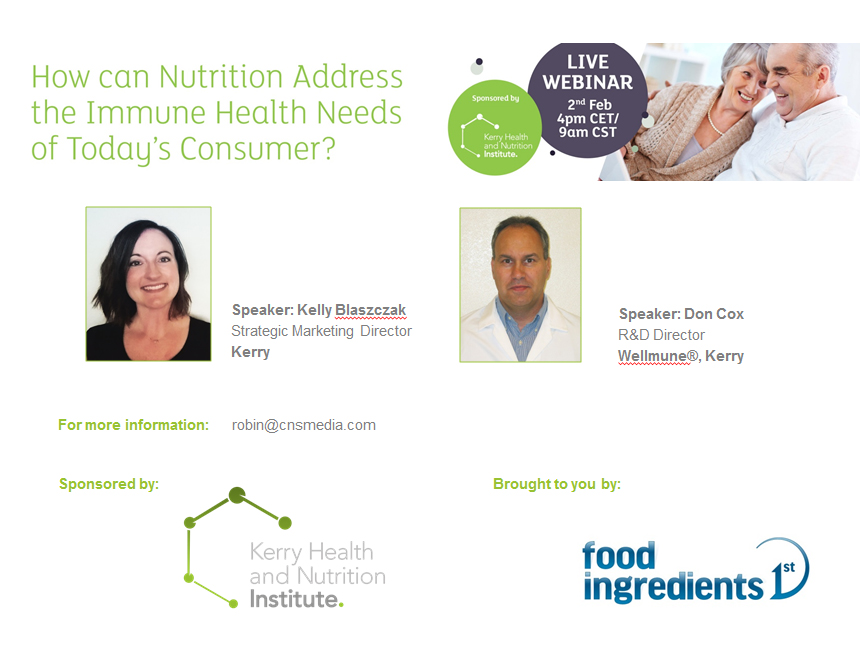
This webinar takes a full view of the immune health space. We take a look at the market and consumer demand and how nutrition can play a key role in immune health. Ultimately, we address how the clinically proven immune health ingredient, Wellmune®, can help create innovative products that meet consumers’ nutrition expectations.
Welcome to all of today's webinar viewers who come from all corners of the globe.
It's great to see so both so many new and familiar names here today.
My name is Robin Wires and I'm the chief editor of CNS Media, which is the publisher of Food Ingredientsfirst.com and the world of Food ingredients.
And today's Food Ingredients First webinar is entitled, How Can Nutrition Address the immune Health Needs of today's Consumers?
And is sponsored by the Kerry Health and Nutrition Institute.
And this aims to translate nutrition, science and policy into actionable insights for the food and beverage industry.
Now I think this webinar is very timely as immunity is a key trend in the industry right now.
Consumers are taking a more proactive approach to their health and wellness, which is causing increased demand for functional foods, beverages and supplements.
Immune health benefits are among the strongest growing demands for consumers who want to support their health through nutrition and the products they consume.
And market insights have shown immune health benefits are popular and growing health platforms for supplements and continue to grow in the food and beverage space.
So today's webinar will take a full view of the immune health category.
We'll take a look at the market and consumer demand and how nutrition can play a key role in immune health.
Ultimately, what we want to address is how the clinically proven immune health ingredients, and immune can help create innovative products that meet, meet consumers' nutrition expectations.
So Kerry, which is a taste and nutrition company, acquired the natural food and beverage and supplement ingredient, Wellimmune at the end of 2015.
And Wellimmune is a 100% natural food, beverage and supplement ingredient that strengthens the immune system, which makes it makes it easier for consumers to be and stay.
And backed by more than 12 clinical studies, it has regulatory approval in major markets around the world.
Now a look at an open market insights data found that Wellimmune has been widely applied in many new product launches worldwide, including toddler formula milk, a range of supplements, juice and juice drinks and sports powders.
A recent product examples utilizing Wellimmune include Optimum Nutrition's Gold Standard, BCAA, Train and recover, which is a line of intra workout drink mixes.
Launched in the UK, Nurture Fruity Water was created for children and is enriched with vitamins, minerals, zinc and Wellimmune to support children's immunity.
So our webinar today will take approximately 30 minutes and consists of two parts.
First, Kelly Blazak, who is the strategic marketing director at Kerry will explain the market and consumer drivers behind immune health with a target with a look at targeted life stages.
Then Don Cox, who is the R&D director at Kerry will give an overview of the immune system and how nutrition impacts it, as as explain how immune can be used to boost the immune system.
So this will be followed by a Q&A session.
So if you have any questions for either of our speakers, and please feel free to send them through to us.
So first, just a few words about our speakers.
The first speaker is Kelly Blazak, and Kelly has spent the last 13 years in various global marketing leadership roles within the food, beverage and nutritional supplement industries.
She holds an MBA, a Bachelor of Science in Marketing, and a certification in digital marketing.
Her most recent role as strategic marketing director for Kerry includes leading the marketing strategies for Kerry's branded immune health ingredients.
And our second speaker is Don Cox, who leads Kerry's technical efforts for the -meaning ingredients.
In his areas of responsibility include clinical research, regulatory filings, product development, and technical services.
Don has significant experience within the commercialization of natural products in the industry.
He's worked exclusively in the natural products industry during his career, and he's held positions with BioTerra, DKSH North America, Cargold and Diamond Fee.
And Dr.
Cox has a PhD in food microbiology from Cornell University and an MBA from the University of Iowa.
But first, Kelly is going to discuss the drivers behind immune health on the market.
So Kelly, the floor is yours.
OK, great.
Thank you for the introduction, Robin, and welcome, everybody.
We're glad you could join us today.
To start things out, Let's take, let's set the stage by taking a look at two large categories, the supplement and the functional food and beverage categories.
Euromonitor estimates that the vitamins and dietary supplements category is at $91 billion for 2016, with a compound annual growth rate of 3.3% for 2021.
They also estimate the functional food and beverage category at $247 billion for the past year with a compound annual growth rate of 3.6% over the next five years.
And Euromonitor doesn't include sports nutrition as part of that estimate, so the category as a whole is even larger if you include that.
But it's important to know really what's driving these growth numbers.
So at a high level, consumers are evolving in their approach to health and wellness.
As Robin mentioned in the introduction, consumers are becoming much more proactive versus the quick fix, reactive approaches in the past.
And we have this global aging population, healthcare cost concerns.
You know, people are, are needing to address real health issues with respect to fatigue, stress, lack of sleep, and all because of this modern lifestyle.
And with information being at our fingertips, all of this is really leading to a fundamental behavior change.
And consumers are using food, beverages, supplements, and of course exercise to accomplish their health and wellness goals.
And now more than ever, consumers are seeking functionality out of these foods, beverages, and supplements.
So as consumers have become more educated on functional foods, their nutrient demands have also become more sophisticated and the industry has been responding to those.
So in the 80s there was this emergence of avoiding negatives, so it's taking something out of a product.
Making something fat-free or making it better for you, such as less sugar, and we definitely still see it today, gluten-free as an example.
And in the 90s, consumers began looking for basic nutrient positives, so added calcium, added fiber, added protein, all things again we still see today.
And in the 2000s and beyond, it has really been about the growth of functional benefits, essentially the tailored for you approach.
And manufacturers are meeting these demands with new innovations, but many products today, they still focus on ingredients versus health benefits.
And so within functional products, where is the white space?
Today we are talking about immune health, and there's a reason for this.
So let's, let's take a look at the demand here.
Globally, 87% of consumers are interested in food and beverages with immune health benefits.
In fact, immune health is the #2 most desired benefit just behind health and wellness, and this shows that consumers are thinking about their immune health more than just during cold and flu season.
But there is a gap here as the slide shows 87% are interested, but only 48% are actively buying.
And that's up from 40% in 2011, so progress is being made here, but this gap is more likely due to the lack of innovation and available product solutions in the space.
And so here we're talking about food and beverage, but according to a global market insights within supplements, Global new products position for immune health actually took over the number one spot in 2016, which was previously held by overall health and wellness position Products.
So immune health awareness and importance are growing, and the market is starting to respond, especially in supplements and infinite and toddler nutrition and dairy, yogurt, fermented beverages.
And sports nutrition and also in ready to drink juice and juice drinks, and these applications really tend to align with consumer targets in the immune health space.
So speaking of consumer targets, let's take a look at some of those target groups.
So of course we know immune health is important to everyone, but it's especially critical for target groups like families with children.
It's normal for young children to get sick 6 to 10 times per year, and we all know that when a child is sick, it definitely impacts the whole family.
Also, athletes and weakened warriors.
We know that intense exercise temporarily weakens the immune system, which can lead to illness or misstraining.
And we have the aging population.
As we age, our immune system, it slows and it weakens, but of course that desire for an active lifestyle does not.
And finally, those who are experiencing lifestyle stress.
Stress suppresses the immune system and unfortunately stress is on the rise.
In fact, 70% of women actually indicate unhealthy stress levels.
So the question is, you know, how do we innovate for the target groups in the immune health space.
And really it starts with targeted nutrition.
So consumers are looking for functional benefits, and as I've shared, there is an untapped opportunity in the immune health space.
However, food, beverage, supplement manufacturers, they need to be elevating beyond current ingredient-based innovation and start communicating the benefits.
Then let's talk about natural in the in the middle there, not only from the standpoint of an immune health ingredient being natural, but also from the stand standpoint of delivery and application.
So part of the reason for the growth in the immune health space, especially in supplements, is that this line is being blurred on what is a food and beverage and what is a supplement.
And the food and beverage is perceived to be a more natural delivery format.
And they're also, they also tend to be more convenient applications.
So, you know, nutritional powders, gummies, beverage shots, the line is really blurring on these, these applications.
And then let's talk about science-backed ingredients here.
Consumers are skeptical, and there's, there is confusion out there, especially in the supplement area, and there really needs to be solid science behind an ingredient and education in place to minimize that confusion.
Trust needs to be built up, and including science-backed ingredients within a formulation that indeed delivers a real benefit is going to benefit the consumer and then in turn the manufacturer as.
And so on the bottom of the screen there're looping this all together is its taste, and we don't really have time to address this in full in today's webinar.
However, it's worth knowing that a product can deliver a strong benefit, but if it doesn't taste good, it's not going to drive repeat sales.
So, hopefully, you've gained some insight around the immune health market, as it relates to consumers, and consumers do recognize that immune health is really, really the foundation of wellness.
And so I'm gonna shift it over, to Doctor Don Cox, who is going to start out by giving us an immunity 101, to really help us understand why immune health is so critical, to the overall health and wellness of consumers.
OK, thank you, Kelly.
And, I look forward to, giving a little overview here on the immune system and, the benefits of nutrition for the immune system.
So your immune system is the body's first line of defense against a range of potential challenges, including, including microorganisms, malfunctioning cells, foreign particles such as pollen, etc.
The role of the immune system is protection.
Its primary role is to protect us against a range of potential challenges, infectious agents like bacteria, viruses, fungi, etc.
And it does this through a complex network of cells and messenger molecules.
So it's our first line of defense against infection, and it is very important to help to maintain balance of the immune of the immune system.
The immune system is broken into two parts for us to more easily understand.
Innate immunity, as we said, is our first line of defense.
It's non-specific, but it's very rapid.
It responds quickly and, and helps to prevent 99, greater than 99.99% of challenges that we face are moved by the innate immune system.
Components include complement, natural killer cells, dendritic cells, monocytes, macrophages, and neutrophils are some of the key ones.
Your adaptive immune system is a slow response system, but it's very specific and it maintains a memory, as you can see in the graphic there above the word adaptive immunity, you can see a young child getting a vaccination.
I think this is the.
A part of the immune system that most of us understand, it's the part that generates antibodies, uses white blood cells, B cells, T cells, etc.
To address challenges in a very specific manner, and it's something that the body maintains memory of so that we're protected long term against some of the more hazardous challenges that we can face in our lives.
There's a number of things that can go wrong in the immune system.
The immune system through various stages, for example, when we're newborn babies, we have a fully functional innate immune system, but our adaptive immune system is immature.
It still needs to gain experience, and this takes time.
So for newborn babies, immune support is a very important function.
Athletes, because of the high intensity training and exercise that they conduct, sometimes have experience, excuse me, immune suppressive events such as happens when you overexert physically.
Finally, as we age, older people experience what's referred to as immunosenescence, and it's a progressive weakening or dysregulation of the immune system that makes us more susceptible to illness as we age.
So these are different challenges that we face in our lives and that.
Our immune systems face, and when we have immune support for all of these, we have a much better chance of preventing illnesses.
And one of the things we can do to support our immune system is to improve our nutrition.
And as we evaluate the impact of nutrition on the immune system, we can see most importantly, it's impacted by what we eat and the foods that we choose, and also the food supplements that we choose to include in our diets.
We can modulate the immune system through nutrition.
It's a very modifiable aspect of our daily lives.
It's defined and that the supplements and nutrients that we choose to consume are important to help to maintain the immune system, and we continue to research new nutritional interventions that can aid people's immune health.
There's a number of factors, nutritional factors that we can use to modulate the immune system, for example, proteins, long chains, long chain polyunsaturated fatty acids, prebiotics, probiotics, vitamins, and certain key functional ingredients such as the whelming ingredient.
Now wellmun is a very important ingredient.
For support of the immune system, it's a natural ingredient.
It's gluten-free because it's a beta 1316 glucan, and we'll explain that in a few minutes.
It's clinically demonstrated to strengthen the immune system, safe for everyday consumption, and it's a global and reputable brand with strong marketing claims and broad regulatorys around the world.
So whelmine is sourced from a proprietary strain of baker's yeast.
After we grow the baker's yeast, we use a, we idolize the yeast to remove the yeast extract, and we start with a cell wall as a starting material for producing the whelming ingredient through a series of water-based wash steps using an alkali and an acid in different steps, we remove noproteins.
Lipids and other materials such that we're left with a highly concentrated region of the cell wall that is the beta 1316 glucan.
Wellmun works in a very interesting manner, and we at Kerry have contributed a lot to the science in this area.
We've supported scientific research and the mechanism of action over the years.
We observed years ago that when wellmune is consumed orally, it's taken up through pyrus patches in the small intestines.
There it's picked up by immune cells called macrophages that circulate immune throughout the body and the lymphatic system.
And once the immune inside of the macrophage, or I should say the macrophage makes its way to various immune organs, it breaks down the immune into smaller fragments, and these fragments then are released to neutrophils, the most abundant immune cell in the body, and once primed by immune, neutrophils are able to more quickly recognize and kill foreign challenges.
So it's a pretty established mechanism of action.
One of the key features for wellmium is that it's a validated scientific-based ingredient with dozens of peer-reviewed published research on the technology, and it's a point of pride for, for Kerry and for the Welling team that we have a lot of research backing this ingredient.
We've Completed numerous clinical studies on the meaning ingredient.
These studies have generally demonstrated that we help to improve and maintain overall physical health, reduce, in a lot of the studies we've reduced the upper respiratory symptoms, infection symptoms that are common with the common cold, and reduce the harmful effects of stress so that we help people to better maintain their health so you don't feel as tired, you don't get fatigued, etc.
And this is because you're maintaining your physical health.
We've studied in a broad range of consumer classes or groups, including marathon runners, exercise-induced stress, typical career paths such as, for medical students, that will work long hours and experience a lot of.
Stress because of being around sick people, lifestyle stress, allergy sufferers, cold, flu sufferers, several children's studies and also research more recently on the aging population have all demonstrated the benefits of the warming ingredient.
We've looked at immune in quite a range of studies.
We've looked at reductions in upper respiratory tract infection symptoms, improvements in the psychological health of subjects, physical and psychological health benefits, because we help to maintain the physical health.
So it's not nothing dealing with mood altering.
It's simply by supporting the immune health of subjects.
They maintain their health and therefore have better energy levels, less fatigue, etc.
And we've also looked at wellming in a couple of allergy studies.
To look at the overall benefits of the ingredient.
Let's talk about some of the studies that we've conducted with, with.
We're going to start by just giving a brief overview of some of the children's studies.
One of the studies that was done had 310 children, 3 to 4 years of age.
The children consumed a milk-based beverage with, that included the Wellmune ingredient and showed in the study that subjects taking the Wellmune had reduced respiratory infections versus a controlled milk product.
A follow-up study done in Brazil that said 1 to 4 year age children in a daycare setting, and these subjects taking the -known beverage had reduced allergies and other ailments, for example, reduced pollen-based allergies, but also eczema was reduced in the subject in these subjects versus the controlled milk product.
And finally, a study we'll go into a little bit more detail on here today.
Children consuming a water-based beverage that contained only the welling ingredients along with a little sweetener had reduced infectious disease, respiratory, and, and several other illnesses were reduced in these subjects, and it was a very interesting study.
So let's, let's go into that study in a little bit more detail.
So this study.
It was a 12-week study, had 156 children aged 12 to 48 months or 1 to 4 years of age, and it was completed in Beijing, China.
And as with all of our studies, this was a randomized double-blind placebo-controlled study.
The primary objective, primary outcome of this study was to observe the health of children after administration of the betta glucan, the one ingredient, and, this was, the study was overseen by a pediatrician.
And she selected the primary outcome as observing the percentage of children that remained completely healthy during the course of the study.
Secondary objectives or outcomes was to record the total number of days and times or incidences of respiratory tract infections and other ailments that children encountered and to record that data as.
Children were divided into three groups receiving 75 mg of the yeast beta glucan, 35 mg of the beta glucan or placebo, and everything was medically verified in the study.
So overall in the study, children taking the immune ingredient were significantly healthier.
You'll see that focusing on that 35 mg dose, that 62% of the children maintained good health during the entire course of the study as evaluated by the pediatrician.
Only 15% of the control group maintained that health, so roughly 4 times as many children in the welling group remained healthy as in the control group.
Also, for children that did get an ailment, that did get an upper respiratory tract infection, the children taking the Loin had 2/3 fewer respiratory tract infections.
You see, the control has roughly 1.5 colds on average for the subjects and about 0.5 for the 35 mg Wing group.
Children taking the Wellmine had 6 fewer sick days over the 12-week period of the study.
The control group had children had on average 9 days of respiratory tract infection symptoms, whereas the Wellmian group had on average only 3.
So the children in the Wing group had fewer sick days.
This translates into fewer days of missed time at school or daycare in this case.
So with the whelming ingredient we have proven immune support for children, it's a strong science-based ingredient with a -defined mechanism of action, strong published safety data, clinically supported immune health benefits.
So for children we've observed in the 3 studies reduced incidence of acute respiratory infection symptoms in children.
Children had shorter duration of colds when they, when they had the immune ingredient in their diet, and also they missed fewer days of school or daycare due to illness.
So let's move on and let's talk about, the other side of the spectrum, the aging spectrum, for the population here, we did this study at Southampton University Hospital in the UK.
100 subjects, 50 to 70 years of age, they were normal healthy subjects, and we had them consume Wellmune or placebo for 90 days.
Wellmune was at 250 mg, and this was medically confirmed respiratory tract infection incidence, and we also did some blood biomarker evaluation in the study.
So in the study, we observed a statistical trend towards reduced days of cold, which means the incidence of the cold.
The P value there is 0.067, suggests really that we would just need to include more subjects in the study and in future studies, we'll, we'll look into that.
Also, we saw changes in some key immune biomarkers, increased interferon gamma and levels of CXCL-9, a couple of key cytokines were statistically significant, and also trends on some other cyts.
IL 12 and IL-10 shown here.
And if you look at the table below, you'll see that the Romine group had more subjects with zero episodes of cold, meaning they stayed healthy.
You see 35 versus 28 there for the placebo.
And when it comes to the number of colds, you'll see that in the placebo group, 16 people had at least one cold, only 13 in the Wyoming group had one cold, and for two or more colds, you'll see that the placebo group had 6 and the Wyoming group had only 2, showing pretty good support for the aging population that we used in this study.
So let's talk about, one more study here, before we wrap up this presentation for today.
This study protocol employed something called the open window effect.
And remember earlier, we were talking about how intensive exercise can suppress the immune system.
So here, we have used that effect to show that, after excessive exercise, you have a quick drop in the various immune biomarkers that last for 2 to 6 hours, and it takes about 24 hours to come back to baseline.
We refer to this as the open window effect because it's, it's a period of time when the subject.
Is a little bit more susceptible to challenges to the immune system.
So in the study protocol, we had 60 recreationally fit subjects.
Each subject consumed 250 mg of Wellmune or placebo, and it was a crossover designed randomized double-blind placebo control.
Crossover is important.
It means that each subject acted as their own control by replicating either wellmune or placebo after their initial test.
So we had the subjects take Wellmune for 10 days.
And we took blood samples and saliva samples at day 0 and day 10, and at day 10 we also had them engaged in a cycling event in a hot and humid environmental chamber that was kept at 100 °F, roughly 60% humidity, and they had to exercise at keeping their VO2 max at about 60%.
And we took blood and saliva samples at various times during the course of or post-study, excuse me.
So, in the exercise stress study, among other biomarkers that we looked at, we looked at salivary IgA.
Salivary IGA is an important immune biomarker.
It's in various mucosal regions of the body and it's an antibody immunoglobulin, whose role is to bind to and prevent challenges from entering, gaining entrance to the body.
Through those, areas such as the mouth and the nose, and you can see here that while both groups, placebo and immune, decreased temporarily during the heavy exercise, the welling group, bounced back very quickly.
Within 2 hours you had immune coming right back up, whereas with the placebo group, it would have taken, about 24 hours to come back to the normal range.
Also, when we look at certain events, we're using here immune to demonstrate that in a simulated infection, infectious event, and here we're using lipopolysaccharide, which is in the cell wall of Gram-negative organisms such as E.
Coli and salmonella, bacteria, I think people will recognize the name of as being potential pathogens.
And what we did here is we took a blood sample from the subjects and then we added the LPS in and we monitor cytokine production, and we want to see a little bit, just a slightly, a few percentage points more of cytokine production.
Versus the placebo over the course of the testing period as a demonstration of how effective wellming can be in terms of getting the immune system to respond and you can see across a range of cytokines we're showing the data here for IL-2 and IL-4, but also for interferon gamma and IL-5, we saw that.
There was a few percentage points increase of the cytokine production, so that suggests that hmine is better able to aid the immune system to prevent a challenge such as this LPS stimulated challenge and demonstrating the cytokine production here is one means of doing that.
So what we see in this study is that subjects taking Wellimmune have their health maintained in a healthy zone, whereas in the placebo group you see you have that normal decrease that occurs in immune biomarkers and then it takes about 24 hours to come back up into the normal range, showing immune support for the immune biomarker ingredient.
So we've previously seen good response in studies of marathon runners, runners and other exercise-induced population, but how does wellmune help with moderate exercise?
In a recent study that was done with just normal subjects from the general population, not athletic people, we saw that wellmun supplementation led to a significant.
Increase in salivary IGA demonstrating that immune may have a positive impact on immune suppression and even less active population.
So these findings support previous, the previous study, the one that I just showed you, and we look forward over the next year to presenting this data.
So we just want to tease a little bit with some future opportunities that we'll have for new data coming out.
So how can nutrition address the immune health needs of today's consumers?
I think if you're paying attention today, you observed that consumers are taking a more proactive approach to their health and wellness, using foods, beverage, and supplements to help to maintain their immune health.
And immune health is a foundation of overall wellness.
If you have your health, you have everything, as they say, and good nutrition is essential to helping to maintain a strong immune system.
And globally there's an unmet need in the market for products with human health benefits, and products with wellmune have a good opportunity to aid in supporting the immune system.
So ingredients that are safe, natural, and clinically proven seem to resonate with consumers, and wellmune is certainly one of those ingredients.
I'll just add in that if there are any questions, I look forward to spending some time answering that during the next few minutes.
Thank you very much.
Thank you very much, Dan and Kelly, for your very interesting presentations on this very topical field of immunity.
So now we're going to go to a few questions and I think there's lots of things to discuss here.
So if you have any questions that you'd like to ask either of our speakers, please send them through.
But I guess what we'll do is we'll start, maybe with you, Kelly, first in terms of looking at what, what type of products, , you can be used in.
This is a question from, from Helen.
Sure, yeah, we can actually use Lamian in many different products.
It's, helpful if it's used on a daily basis.
It has that healthier halo.
It, it's, convenient formats tend to work best, but we have products that have been launched in over 60 countries.
Some of the more recent launches include Gold Standard BCAA Train and Recover, that's a sports nutritional powder drink from Optimum Nutrition.
There's a new gummy that launched in the US by Ali called Kids Mighty Immunity.
There is an improved version of Nurture Fruity Water which was launched in the UK.
And and another a dairy beverage, New Hope, Dairy Star of Hope.
It's a line of children's dairy-based beverage for kids in China.
So we've seen a lot of, a lot of product launches in the last year, and really in the last 5 years in particular.
Are there any categories that are really particularly on the rise right now or things that, because obviously, it's gotten much more tradition, I guess, in the supplements field, but maybe the functional food is becoming more open to this type of ingredient.
Yeah, absolutely.
With the growth of functional foods, absolutely, and looking at data from Intel and Anova Market Insights, we see some of the top categories as being, toddler formula, dairy drinks, ready to drink beverages, really with nutritional beverages from the sports nutrition side and nutritional bars.
So yeah, we're seeing, we're seeing a lot of growth, which is great.
OK.
For you, for you, Don, I guess it'd be very interesting to find out a little bit about, some of the issues that have been done into particular demographic groups.
So are there, Are there any kind of particular categories where you've done a lot of population studies into.
Oh, sure.
Absolutely.
We've, we've focused on a, a wide range of, of, population groups.
So starting from the very young, we've done, there's been 3 studies done with young children, 1 to 4 years of age, and we presented one of those studies today.
We've also done, your, your average college student, the 18 to 22 age, with some of the exercise induced stress studies.
Marathon studies have included people probably from, from about, 18 until people in their 40s and 50s.
We have a women's study, average age is 38 plus or minus 12 years, and, of course, we have the healthy aging study, of, of subjects 50 to 70 years of age.
So we've done a wide range of studies over the years, and we continue to expand the, the clinical database of research on.
Can, can pregnant or lactating women use mean?
With any very specific, health situations, such as, as, a pregnant woman or a lactating woman, we generally recommend that they discuss it with their healthcare professional, just for peace of mind.
Wellmune is a very safe ingredient, has very, very good safety data, both published and, and observed in our clinical studies, but, with particular conditions, situations such as pregnancy, I would recommend that they just discuss it with a healthcare professional.
OK.
Amber was asking, have there been any studies done on the 25 to 35 year age group specifically?
Broken this down?
Yes, we have certainly done studies with, subjects in that, in that age range.
Generally, when we design a study for adults, it would be 18 to 65, and, many of the studies would, would tend towards, a lower age, just because of the demographics where we do studies at universities and such, there's generally a lot of younger people.
So, inclusive in those studies would be that 25 to 35 year age group, but we have not done a study just with that particular age group.
And there was an interesting question here, just in terms of the time of year maybe that some of the studies were, were done.
Does, does that have any impact on, on the efficacy or, or when it comes to immune health, I guess, because perhaps winter is more important.
Yes, of course.
Sorry for, for interrupting your, your question there.
Yes, if we're looking to evaluate the immune health of people, we're always starting with normal healthy people, but if we want to consider immune health during, cold and flu season, for example, we're going to do that in the northern hemisphere.
We're going to do that anytime between, let's say, starting in September, October through about April.
But if we're looking at, at biomarker responses, for example, we, we will start at almost any time of the year.
We can do studies starting in February and April, and etc.
So, if we do any, any specific design of studies, if we're looking at, health during cold and flu season, we might start in the, in the fall or, or, or, winter, but other than that, we do, we'll start them any time of year.
OK.
I guess back coming back to you again, Kelly, I guess one of the key issues when it comes to marketing of supplements is, is the claims that you make.
And Veronica asked a very interesting point here.
What, what, what are the claims that are allowed.
From EFSA in Europe or from the FDA in the US in case of adding Wellimmune to your products, are there, are there any approved claims from that regard?
Yeah, so that's a great question.
Immunity claims that can be made about Wellmune vary by region and vary by country, especially as it relates to food and beverages.
For example, in the US, a structure function claim can be made.
Another example in South Korea, there is an approved claim which may support immune function.
Yet in many countries, A claim cannot be made due to the regulatory environment, so there is no current EFSA approved claim for Wellimmune.
However, with, with Wellmune, consumers get a real immune health benefit which has been proven out by many of the clinical studies that some of which Don shared with you today.
And we have seen a lot of growth in products with Mammune being launched not only in Europe but, you know, in over 60 countries as I mentioned earlier, many of these have the same barriers around claims, and this growth is because manufacturers are wanting to innovate with ingredients that deliver a real immune health benefit which is backed by credible science, therefore delivering on consumers' desires for safe.
Natural and clinically proven ingredients.
So we have also seen manufacturers innovate with Wmune for its proven benefits and then formulate with the addition of a commodity ingredient such as vitamin C in order to be able to make an immune health related claim in markets like that.
The last thing I'll mention is around the Whelming brand.
We make the Wellming brand accessible to consumers through our logo, our website, our social media engagement, and these vehicles provide avenues for consumer education and help in communicating the immunity and wellness benefits, and many of our customers choose to link to these platforms as.
So it just really helps close that information gap that can exist when formulating with functional ingredients.
Fair enough.
OK.
And, Helen asks a very simple question, but I think it's kind of important.
What, how does the ingredient have to be labeled?
And it depends on the geography.
In the United States, it's labeled as baker's yeast, beta glucan, as the source is a proprietary strain of baker's yeast.
In the EU, it's labeled as yeast beta glucan, and in other geographies such as China, for example, it's also labeled as yeast beta glucan.
So as long as you put something in there about the yeast beta glucan or baker's yeast beta glucan, I think it's properly labeled.
OK.
And John, another question we get here from, from Lucas, is there, is there any challenge in terms of, in terms of taste when applying Wellmune?
Generally in a food or beverage matrix, you have a number of competing factors that impact taste, so a Wellmune by itself, the wellmune dispersable, may have some flavor of its own, but generally it's easily masked in food formulations.
OK.
And another interesting question here is just, in terms of from a technical point of view from Takashi, how, what's the heat stability of the, of the ingredient?
Wellmune is stable to the typical food processing parameters.
So we've, we've put it through retort.
We've put it through pasteurization, as as, , high temperature processing.
So your normal, food processing parameters are not going to have an effect on the stability of the Wellmune.
OK.
And, I think this one is kind of interesting just in terms of, when it was addressed to you.
Kelly, I'm not sure if Don would prefer to, to answer, but Kelly, you, you mentioned that immune health wellness is important for children.
How has this been seen in the market of infant formula or child food?
Yeah, I can, I can go ahead and answer this, you know, as I mentioned earlier, as far as new products go, toddler formula is definitely up there with new products with immune health claims.
So because of the importance of immune health to children, we're seeing a growth in this.
We've seen it with Wellmune as and products launched with Wellmune.
So this is, this is definitely a key area to making sure that kids are staying healthy.
OK.
And maybe just finally 11 last question for, for you, Don, just in terms from Joseph, what, what are the benefits of yeast, of this yeast, bettaagglucan instead of mushroom betagglucan, because I heard that, fungus is more effective.
Sure.
We can only go with the science, and, there's been one comparison study done.
It was an animal model study published in 2009.
Where the Wellimmune ingredient was compared against, I think, 4 or 5 different, mushroom beta glucan products in a, in a mouse model, and the Wellmune outperformed the other ingredients significantly.
It was a mouse survival study in a, in a particular model, and I think 80 or 90% of the mice in the Wellmune group survived, whereas only 30 to 40% of the mushroom, group survived.
So, those are, you know, that, that's about the only type of comparison study that, that has been done.
We have a lot of published research and science on the Wellmune, including published safety data, mechanism of action, as as all the clinical studies.
So we have a significant database showing the efficacy of the Wellmune, and I would, I would let that rest for itself.
OK.
That's about all we have time, for today.
I'm sorry if we didn't get around to answer your questions, but, for those, we've had so, so many responses today that if you, have anything that you would like to ask, just please, send an email to me to Robin@cnsmedia.com.
And we will have Don or Kelly get back to you about it.
So my thanks again to Kelly Blazak and Don Cox for, for today and for your information, a link to the on-demand version of the webinar will be sent to your email within the next couple of days.
And of course, if you have any further questions or inquiries, feel free to, to send an email to Robin at CNS Media or visit food ingredientsfirst.com in order to keep up to date with developments in the food ingredients space.
So we'll be looking forward to welcoming you to several coming webinars in the coming months.
So please stay tuned with us to hear what's what's coming up.
But for now, thanks again for your attention and have a great rest of the day.
Thank you, everybody.
Thanks, Aaron.