


Wilmar H1 2026 profit rises as soybean crushing and tropical oil margins strengthen


Key takeaways
- Wilmar’s H1 2026 core net profit rose 9.9%, supported by stronger tropical oil refining margins and higher soybean crushing activity.
- Feed and Industrial Products pre-tax profit jumped 54.9%, while China feed demand helped lift oilseeds and grains volumes.
- Food Products grew sharply following the AWL Agri Business consolidation, while weaker sugar prices and lower palm output pressured upstream operations.
Wilmar International has posted stronger first-half earnings compared with the prior-year period. Improving tropical oil refining margins and rising soybean crushing activity in China bolstered its agribusiness operations amid weaker sugar milling and lower palm crop production.
The Singapore-headquartered agribusiness giant reported core net profit of US$641.5 million for the six months ended June 30, up 9.9% year over year. Pre-tax profit rose 12.8% to US$1.06 billion, while net profit increased by 2% to US$608.9 million. Revenue climbed 17.2% to US$38.56 billion.
Wilmar attributed much of the revenue increase to the consolidation of AWL Agri Business, formerly Adani Wilmar, since December 2025, alongside higher selling prices across most product categories.

For food and ingredient manufacturers, however, some of the more notable signals sit further upstream. Wilmar reported improved processing economics for tropical oils and oilseeds against continued volatility in agricultural commodity markets.
Soybean crushing gains on Chinese feed demand
Wilmar’s Feed and Industrial Products division, encompassing tropical oils, oilseeds and grains, and sugar, recorded a 54.9% jump in pre-tax profit to US$591 million.
The company pointed to stronger performance across most of the segment, including improved tropical oil refining margins and volumes. Tropical oil sales volumes edged 1% higher to 12.7 million metric tons during the half.
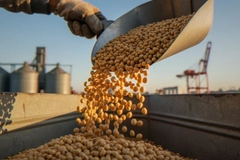
Oilseeds and grains were more dynamic. Rising feed demand in China supported increased soybean crushing, lifting sales volumes 6.1% to 14.9 million metric tons. Revenue from oilseeds and grains grew 16% to US$5.58 billion.
The figures point to sustained demand from China’s feed sector, supporting higher soybean crushing activity and associated oilseed processing volumes.
At the same time, the company’s balance sheet reflects firmer raw material costs. Wilmar said higher soybean and palm commodity prices contributed to inventories rising 3% to US$15.09 billion and net loans and borrowings increasing by US$707.6 million to US$20.67 billion.
AWL reshapes food products business
Wilmar’s Food Products division also delivered sharply higher earnings, with pre-tax profit rising 55.7% to US$304.6 million.
Sales volume increased 19.1% to 19.4 million metric tons, while revenue jumped 35.2% to US$19.36 billion. Consumer Products volumes were up 40%, and Medium Pack and Bulk volumes rose 12%.
Excluding AWL, Wilmar said Food Products volumes would have risen 2% to 16.6 million metric tons, while revenue would have increased 8% to US$15.54 billion.
Wilmar also cited volume growth in its existing oils and flour operations, as well as a gain from the disposal of joint ventures in China, as contributors to the segment’s performance.
AWL’s consolidation increases Wilmar’s exposure to India’s food sector and brings AWL’s results into the group’s consolidated financials. The business spans edible oils, food staples, and other consumer food categories, adding scale to Wilmar’s already extensive processing and distribution footprint across Asia.
Palm and sugar face upstream pressure
The stronger refining and crushing performance contrasted with pressure in Wilmar’s Plantation and Sugar Milling division, where pre-tax profit fell 32% to US$137.7 million.
Weaker sugar prices weighed on the milling business, while Wilmar recognized a US$24.7 million impairment on sugar milling assets in India.
Palm plantation operations were also affected by weaker production in Indonesia. Fresh fruit bunch production fell 6.2% to 1.92 million metric tons, and crude palm oil output declined 4% to approximately 716,000 metric tons. Despite lower production, palm plantation revenue rose 2.6% to US$1.14 billion on higher palm oil prices.
This divergence — improved downstream tropical oil refining margins alongside lower upstream crop volumes and higher palm oil prices — underscores the mixed conditions facing the edible oils value chain.
Looking ahead, Wilmar flagged continued geopolitical uncertainty and commodity market volatility, including heightened volatility linked to the ongoing Iran conflict. Chairman and CEO Kuok Khoon Hong said the company expects “operating conditions to remain uncertain due to continuing geopolitical developments.”
The company nevertheless expects its full-year results to be “satisfactory,” supported by its integrated operations and broad geographic footprint.



Upcoming webinars

Oat-Standing Ingredients - Showcasing Irish Grain Through Innovation
Tirlán Ingredients

2027 Food Safety Risks for Quality & Compliance Leaders
FoodChain ID

Formulating for function: Developing benefit-led beverages with natural colours, botanicals, and flavours
Givaudan Sense Colour