



Lasenor debuts pea protein texturizer for bakery amid egg price volatility

Key takeaways
- Lasenor launches VP-100 pea protein texturizer, enabling 50-100% egg reduction in muffins and cakes, developed with Meala FoodTech.
- US egg prices rose 65% in 2024 amid avian flu outbreaks, as Innova data shows 13% growth in plant-based egg launches from 2020-2024.
- Lasenor opens a new technical center with a bakery lab to support manufacturers in formulating plant-based baked goods.

Bakery solutions firm Lasenor has launched a texturizing pea protein designed to reduce egg use by 50-100% in muffins, cakes, and other baked goods, as volatile egg prices and growing consumer demand for plant-based options push manufacturers toward alternative ingredients.
The ingredient, VP-100, was developed in partnership with Israeli food tech company Meala FoodTech and debuted last week at Fi Europe 2025 in Paris, France. Lasenor says it enables manufacturers to achieve comparable volume, texture, and moisture in baked goods while supporting clean label and allergen-free claims.
Egg supply under pressure
The launch comes amid ongoing egg price volatility driven by successive waves of highly pathogenic avian influenza (HPAI). In the US, the price of a dozen eggs rose by 65% in December 2024, hitting a national average of US$4.15 compared to US$2.51 a year earlier, according to the US Bureau of Labor Statistics.

The US Department of Agriculture has described egg prices as “the most volatile category” it tracks and predicts a further 50% increase in 2025.
The avian flu outbreak has affected 154 million birds in the US since February 2022, with around 13 million dying or being culled since December alone, according to the USDA. This supply crunch, combined with strong consumer demand, has put pressure on food manufacturers reliant on eggs for functional purposes in baked goods, sauces, and other applications.
In Europe, similar dynamics have played out. Lasenor cites price increases of 50–90% across EU markets, creating what the company describes as “forceful pressure” for more stable alternatives.
Meanwhile, Innova Market Insights data reveals a 13% rise in plant-based egg product launches between 2020 and 2024, with brands innovating across scramble substitutes, liquid egg replacements and bakery-focused solutions.
“Food manufacturers are actively seeking solutions that allow partial or full egg reduction, especially in light of the volatile egg supplies and price fluctuations,” says Viktoriia Kubrakova, product manager for VP-100 at Lasenor.
How VP-100 works
The pea protein functions as a single-ingredient solution for aerated batter systems, enhancing foam stability, producing a softer crumb, and extending shelf life by slowing the staling process. Lasenor developed the ingredient using Meala FoodTech’s proprietary texturization technology, then optimized it specifically for bakery applications.
For optimal performance, VP-100 undergoes a controlled hydration and activation phase before being integrated with other ingredients — allowing it to develop gelling, binding, and water-retention capacities critical for egg-reduced systems.
The activated protein enhances foam stability to maintain air retention during baking. In trials using 45 g cavity molds baked at 180°C for 20 minutes, the ingredient produced muffins with volume, softness, and moisture comparable to full-egg recipes, according to the company.
“Our trials demonstrate that VP-100 integrates smoothly into standard cake recipes without requiring changes to the processing methods,” says Kubrakova. Applications extend to sponge cakes, pound cakes, and brioches.
The ingredient supports on-pack claims including “100% plant-based,” “egg-free” and “clean label” — positioning that aligns with broader consumer trends toward transparency and simpler ingredient lists.
Nearly one in two consumers globally purchased more fresh, unprocessed foods over the past year, according to Innova Market Insights, with around 30% actively reducing processed foods and seeking products with recognizable, minimal ingredients.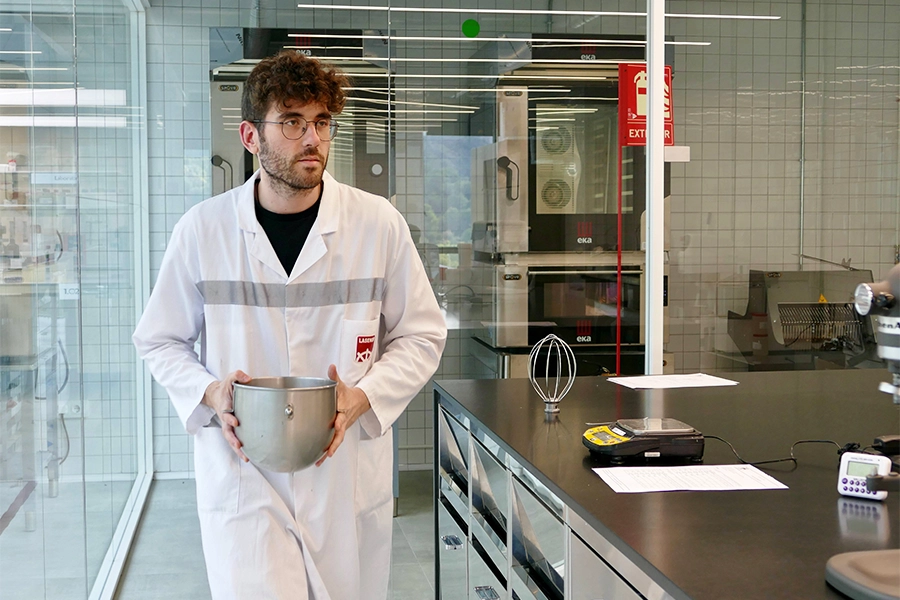 Viktoriia Kubrakova, product manager for VP-100 at Lasenor, says food manufacturers increasingly demand egg-reduction solutions amid volatile egg supplies and price fluctuations.
New technical center opens
Alongside the product launch, Lasenor has opened a new technical center housing a fully equipped bakery lab. The facility is designed to provide industrial bakery manufacturers — including cake mix producers — with on-site support for formulating plant-based concepts.
The center offers recipe testing, process optimization, and product validation under real manufacturing conditions. Lasenor says the approach positions the company as an “application-driven partner” rather than simply an ingredient supplier.
“Our customers can test recipes, optimize processes, and validate product performance under real manufacturing conditions,” says Chiara Marinanza, marketing director at Lasenor.
“In addition, customers will benefit from Lasenor’s applications expertise, formulation know-how, and direct market access to the bakery industry.”
The company operates multiple application labs and pilot-scale facilities globally, with headquarters in Spain and production sites and commercial offices across Europe, the Americas, India, and Asia. Its portfolio spans clean label solutions, plant-based ingredients, lecithin, bakery systems, and release agents.