

UK pilot program shows how organic food can be affordable and profitable

Key takeaways
- UK pilots generated £8.78 (US$11.15) social value per £1 (US$1.27) invested by connecting organic growers directly with low-income communities and schools.
- The program addressed supply gaps, missing processing infrastructure, and food desert access barriers through subsidies and farmer-direct distribution models.
- Welsh growers increased acreage 20% while Scottish schools cut meal emissions 42% using local organic split peas.
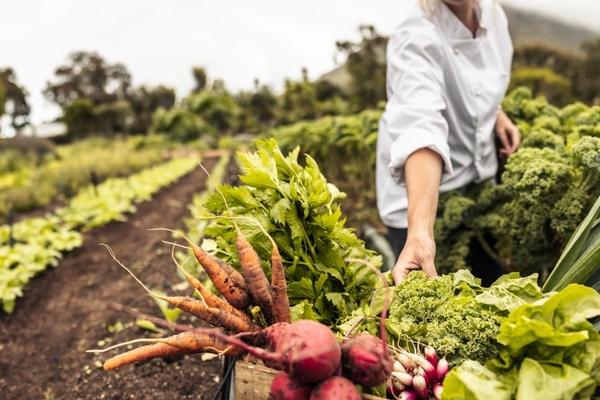
A three-year UK program delivered £8.78 (US$11.15) in social value for every £1 (US$1.27) of public money spent subsidizing organic produce for low-income households and schools. The findings show that the F&B industry can profit from the organic sector while providing affordable food to consumers.
The Bridging the Gap program, funded by the National Lottery Community Fund, ran nine pilots across England, Scotland, Wales, and Northern Ireland between 2022 and 2025.
Results released this month show the pilots reached 2,500 low-income households and 75,000 schoolchildren, while generating measurable returns in health improvements, local economic growth, and emissions reductions.
Economic modeling by the University of Portsmouth and the Organic Research Centre broke the £8.78 return into £3.11 (US$3.95) in health improvements, £3.94 (US$5) in community benefits, £1.44 (US$1.83) in local economic growth, and 29p (US$0.37) in climate and nature gains.

The mechanism was direct. The program subsidized the typical 25-50% price gap between organic and conventional produce while connecting small and medium-sized organic growers to local retailers, farmers’ markets, food cooperatives, and school kitchens.
Three problems, three fixes
The pilots identified structural barriers that conventional retail hasn’t solved.
Insufficient supply: The UK produces only 35% of the consumed fruit and vegetables, with minimal organic production. But guaranteed public procurement changed grower behavior. Welsh participating growers increased vegetable acreage by 20% during the pilot period, even as national production declined.
Missing infrastructure: Processing capacity for small and medium organic growers has been hollowed out by supermarket centralization. Organic peas grown in Aberdeenshire in Scotland had to travel to the Midlands in England for processing before returning to Scottish schools. The Welsh Veg in Schools pilot funded on-farm equipment to shorten this chain. In London, Growing Communities provided wholesale aggregation that multiple growers said eliminated “delivery stress” from direct sales.
Access gaps: Queen of Greens, a mobile greengrocer, brought organic produce to 700 people weekly in Liverpool and Knowsley — areas with limited fresh food retail. Cardiff’s Planet Card scheme used subsidies to make farmers’ market shopping viable for low-income households.
One Aberdeen farmer, Phil Swire, supplied organic split peas to 360 schools through Bridging the Gap funding that covered the price difference schools couldn’t pay. Adding peas to the traditional mince recipe — the most popular dish in Aberdeen school meals — cut emissions per serving by 42% without reducing uptake.
Market context
The results come as consumer attitudes toward organic create conflicting pressures. Innova Market Insights reports that while organic claims lead in Europe, “price has become a more important factor for consumers, for which organic products are usually on the higher end.”
But Innova data also shows that 38% of consumers globally cite planetary health as their top concern, and 64% want straightforward sustainability messaging on packaging. Despite organic being a common claim, consumers remain skeptical about its benefits — though 33% say independent certifications increase trust.
The Bridging the Gap model addresses both barriers. Direct farmer connections provided transparency. Strategic subsidies in schools and voucher programs eliminated the price barrier in targeted settings without requiring market-wide adoption.
For suppliers and manufacturers, the policy recommendations signal potential procurement shifts. The UK government is committed to sourcing 50% of public sector food from local or sustainable sources. The £5 billion (US$6.35 billion) annual school and hospital food budget could reshape demand if school meal standards incorporate organic quotas.
The numbers
Local multiplier effects generated £75,340 (US$95,682) in additional local spending beyond direct farmer payments. Organic farmers earned £154,303 (US$195,965) in new revenue across the pilots, with £59,792 (US$75,936) representing net new income after accounting for displacement.
The report calls for cross-departmental horticulture strategies, investment in pulse and vegetable processing infrastructure, strengthened supply chain fairness regulations, and scaled voucher schemes for low-income households.
Whether the UK implements these recommendations is unclear. But the data shows the affordability-sustainability tradeoff in food systems isn’t inevitable — it’s a function of supply chain structure that can be changed.